
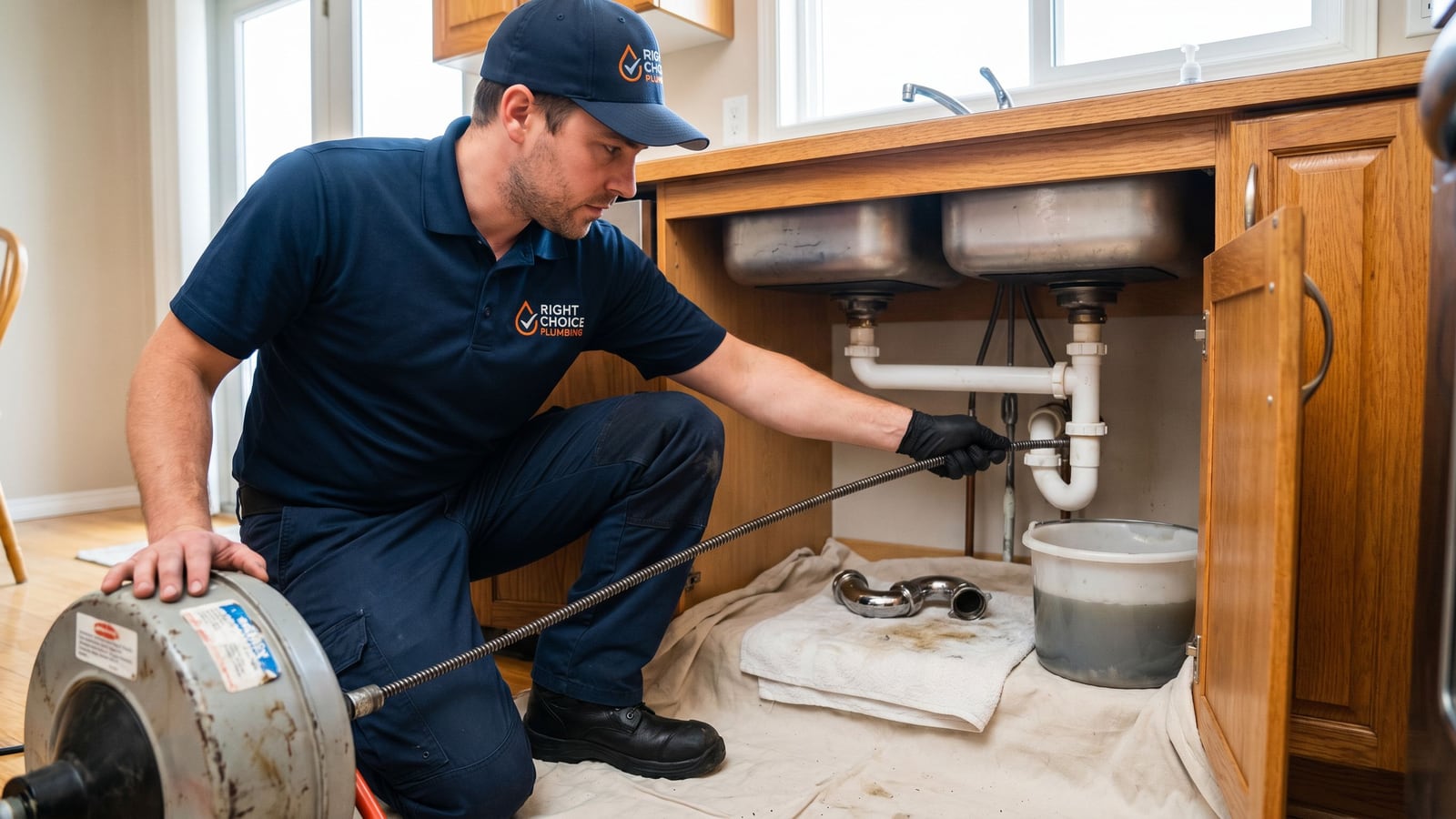
Slow kitchen drain that won't clear, even after you have plunged it, poured boiling water down it, and snaked it once already? This guide walks through why kitchen lines clog in the first place, the exact drain snake vs hydro jet decision an Edmonton plumber makes at the sink, what each method actually does inside the pipe, and what both cost in 2026, so you know within five minutes whether a quick snake will fix it or whether you are throwing good money at a pipe that needs hydro-jetting.
A slow kitchen drain rarely fails overnight. It creeps. The sink takes a few seconds longer to empty, then it gurgles, then you are standing in two inches of grey dishwater watching it inch down while the disposal hums uselessly. By the time most Edmonton homeowners call us, the line has been slow for weeks and someone has already tried a bottle of chemical drain cleaner that did nothing but sit there.
We clear kitchen lines, branch drains, and main sewers every week across Edmonton, Calgary, and Greater Vancouver, so the patterns below come straight off the job: grease welded to the pipe wall, hard-water scale narrowing the bore, and clogs that come back a month after a snake "fixed" them. Below we walk through what is happening in your pipe, when a drain cleaning snake is the right tool, and when only hydro-jetting will actually solve it.
Key Takeaways
- A first-time, single-fixture slow kitchen drain is usually a snake job: 30 to 60 minutes and roughly $100 to $250 to punch through the clog and get flow back. Snaking a chronic grease line buys you 3 to 6 months at best.
- Hydro-jetting blasts 1,500 to 4,000 PSI of water through the line to scour the full pipe wall back to bare pipe. It removes the grease and scale a snake leaves behind, lasts 2 to 4 years, and runs about $350 to $950 for a residential line in 2026.
- The single biggest reason a slow kitchen drain won't clear for long in Edmonton is grease plus hard water. Cooking fat congeals on the pipe wall and Edmonton's hard tap water cements mineral scale on top of it, so a snake just bores a hole through a tunnel that closes again.
- If the same drain has been snaked more than once in a year, or multiple drains are slow at once, the problem is wall-to-wall buildup, not a single blockage. That is a hydro-jetting job, ideally after a quick camera look.
- Snaking clears a path. Hydro-jetting cleans the pipe. Match the tool to the clog and you stop paying to clear the same drain twice.
Why your slow kitchen drain won't clear
The kitchen line is the hardest-working drain in the house and the one most likely to clog. Everything that goes down it is sticky: cooking fat, oil, food particles, coffee grounds, soap, and starch. Understanding what is actually building up in there tells you, before anyone touches a tool, whether you are dealing with a snake job or a jetting job.
Grease is the number one culprit
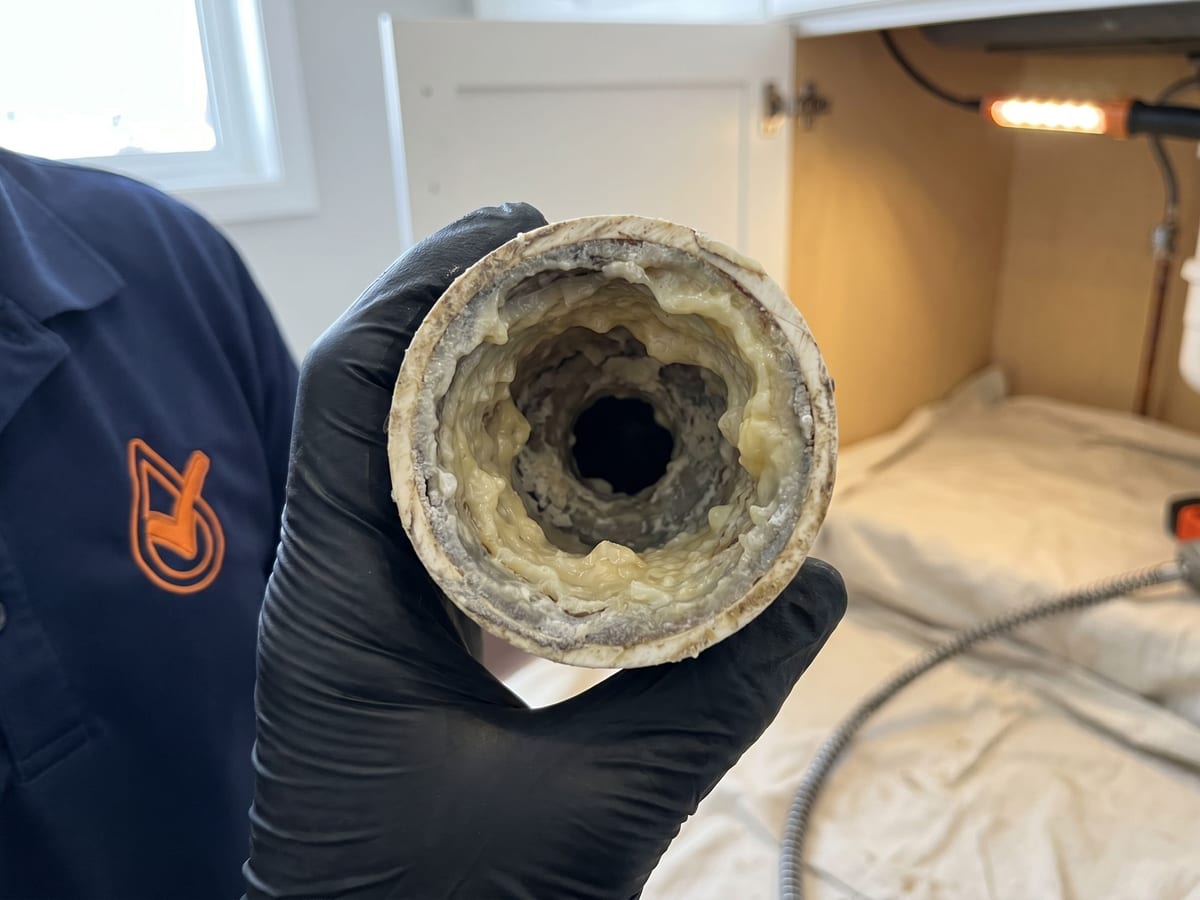
Fats, oils, and grease go down the sink as a hot liquid and look harmless. A few feet down the pipe they cool, congeal, and stick to the wall like candle wax. Each wash cycle adds another thin coat. Over a year or two that coating narrows a 1.5 inch kitchen line to a fraction of its diameter. EPCOR, which runs Edmonton's drainage system, is blunt about it: when fats, oils, and grease are poured down the drain they cool and harden in the pipes, building up until wastewater cannot get through. That is exactly what is happening on a small scale inside your kitchen branch.
Edmonton's hard water makes it worse
This is the part most generic "snake vs jet" articles miss because they are not written for Edmonton. Our tap water is hard. EPCOR rates the North Saskatchewan River source at about 165 mg/L of calcium carbonate, which works out to roughly 10 grains per gallon. For comparison, Vancouver's mountain-reservoir water sits near 5 ppm, more than thirty times softer. All those dissolved minerals drop out and bind into the grease layer, so an Edmonton kitchen line does not just collect soft fat, it builds a hard, scaly composite on the pipe wall that a snake cable cannot scrape off.
Food, coffee grounds, and the disposal myth
A garburator does not make food disappear, it just chops it smaller before sending it down the same greasy pipe. Coffee grounds, eggshells, rice, pasta, and fibrous vegetable peels are notorious for packing into the grease layer and forming a dense plug. If your kitchen has a disposal and a recurring slow drain, the disposal is very often feeding the clog, not preventing it.
A venting or slope problem hiding underneath
Sometimes the line clogs because it was never draining properly to begin with. A branch with too little fall, a flat run, or a blocked vent will drain sluggishly and trap solids that a steeper, properly vented line would carry away. If a freshly cleared drain goes slow again within days and there is no grease to explain it, we look at slope and venting before reaching for a bigger machine.
Snaking vs hydro-jetting: what each one actually does
Both tools restore flow. They do it in completely different ways, and the difference is the whole decision. The short version: a snake makes a hole, a jetter cleans the wall.
How a drain snake (auger) works
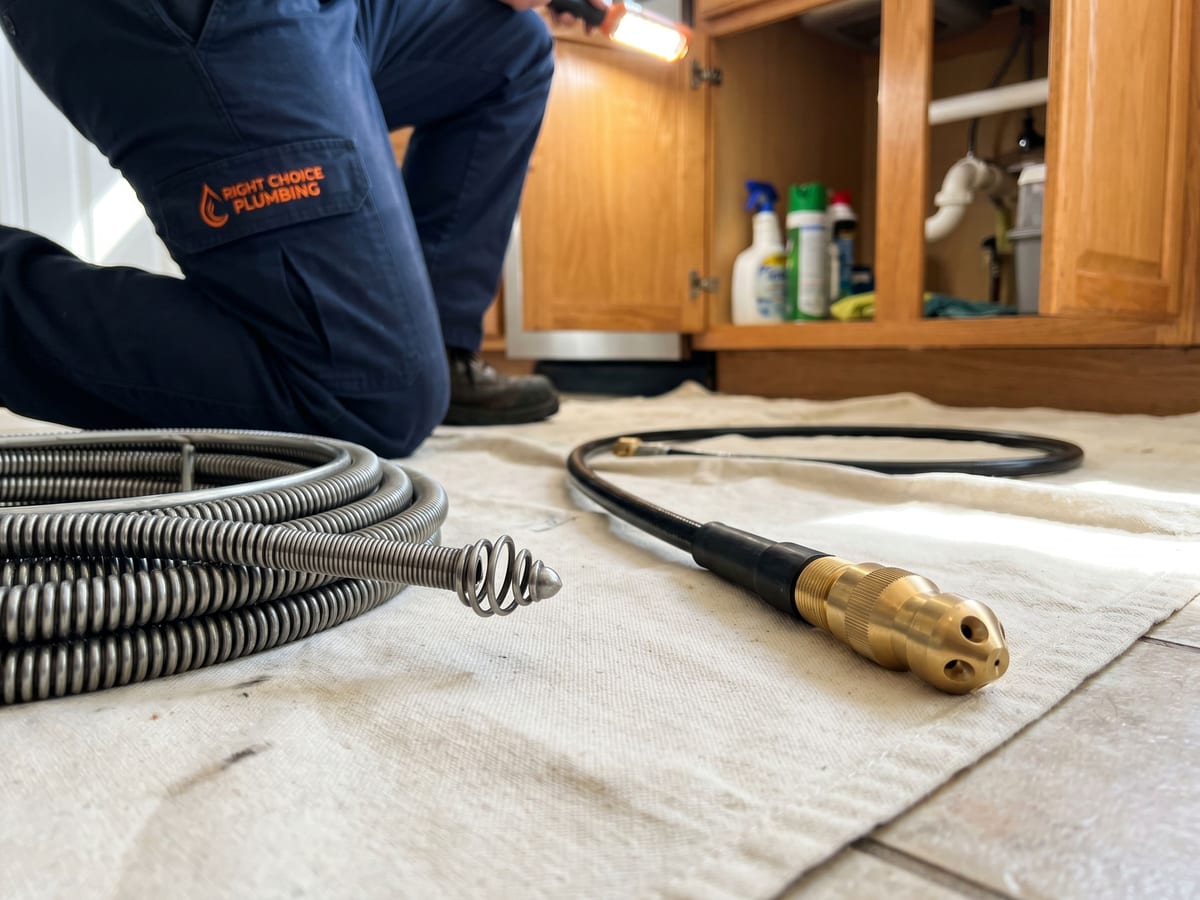
A drain snake, also called a cable machine or auger, feeds a flexible steel cable down the line. A motor spins the cable, and a cutting or retrieval head on the end bores through the blockage. For a discrete clog, a wad of food, a hairball at a junction, a foreign object, this is exactly the right tool. The head punches through, you get flow back, and the job is done in under an hour. Augering and snaking are the same family of tool, just different head and cable sizes for different lines.
The limitation is what the cable does not do. It bores a hole through grease and scale, but it does not strip the coating off the pipe wall. The pipe still has a rough, sticky tunnel through it, and that surface starts catching debris again the moment you turn the tap back on. On a grease line, a snake is a reset button, not a fix.
How hydro-jetting works
Hydro-jetting feeds a high-pressure hose with a multi-port nozzle into the line. Forward jets cut through the blockage while rear-facing jets drive the hose deeper and, critically, scour the full circumference of the pipe wall as the hose is pulled back. Residential jetting typically runs between 1,500 and 4,000 PSI depending on the pipe. Instead of a hole through the grease, you get the grease, scale, soap, and sludge flushed out of the system, and the pipe restored close to its original inside diameter.
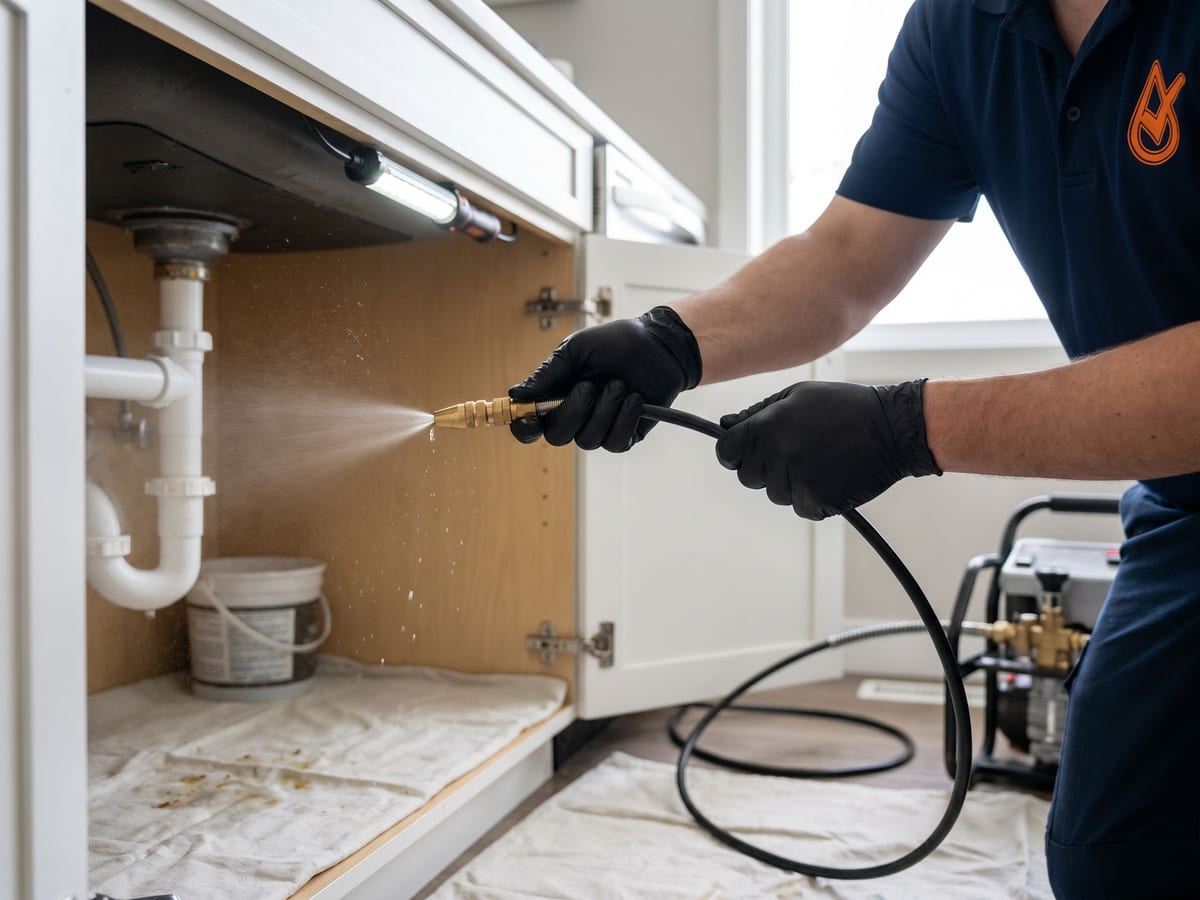
EPCOR uses the same principle on the public side: when the city's wastewater pipes silt up with grease, crews clear them with high-pressure water and then vacuum the dislodged material out. Hydro-jetting your kitchen line is that process scaled down to your house.
Why the snaked drain clogs again in a month
This is the question we get most. You snaked it, water flowed, and four weeks later it is slow again. The answer is simple: the snake never removed the grease, it just opened a channel through it. The channel had a rough, greasy, scaled wall, and in a hard-water city like Edmonton that wall is the perfect surface for the next round of fat and minerals to grab onto. The clog did not come back because the snake failed at its job. It came back because snaking was the wrong job for a grease line.
When snaking is the right call
Reach for the snake when the clog is a single, recent event rather than a symptom of years of buildup. In these situations a snake is faster, cheaper, and completely adequate.
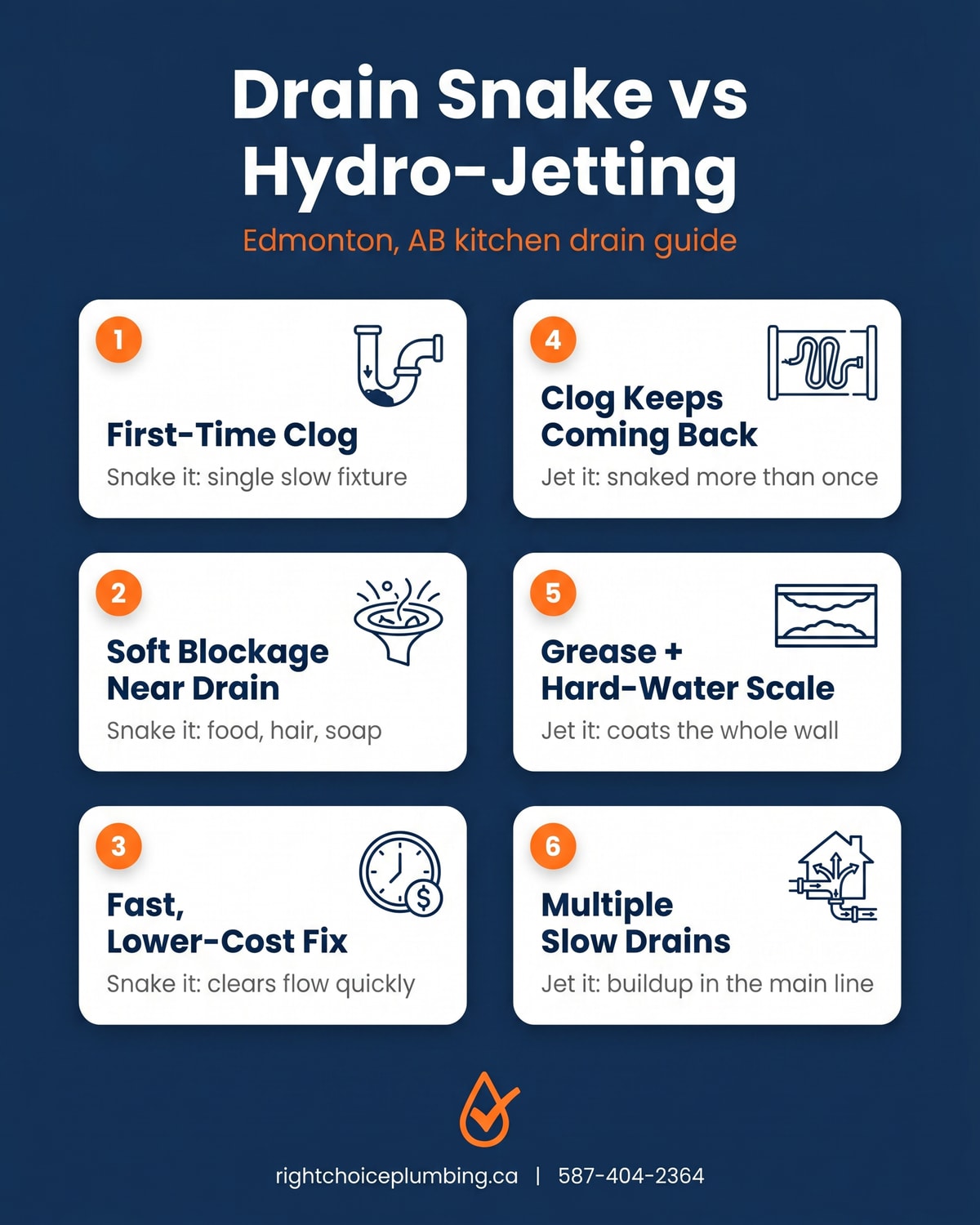
1. A first-time clog in one fixture
If only the kitchen sink is slow, it has never done this before, and the rest of the house drains fine, you almost certainly have a discrete blockage close to the fixture. A snake clears it and you are done. No need for the bigger machine.
2. A soft, nearby blockage
A wad of food, a build-up of coffee grounds in the trap arm, or a foreign object that fell down the drain are all soft, local clogs sitting within a few feet of the sink. The cable reaches them easily and pulls or punches them clear.
3. You need flow back fast and cheap
A snake is the lower-cost, faster option. When the issue is a one-off and the pipe is otherwise healthy, paying for a full hydro-jet would be overkill. We will tell you that to your face rather than upsell you.
4. The line is older or fragile
Very old, thin-walled, or already-cracked pipe may not tolerate high-pressure jetting. On a delicate line we will often choose a gentler cable head, or recommend a camera look first, instead of putting 4,000 PSI through a pipe that could fail under it. Matching the method to the pipe's condition is the safety call.
When you need hydro-jetting instead
Hydro-jetting is the answer when the problem is the pipe wall, not a single blockage. These are the signs that a snake will only ever be a temporary patch.
1. The same drain keeps clogging
If a drain has been snaked more than once in a year, the clog is a symptom, not the disease. Wall-to-wall grease and scale are rebuilding faster than a cable can keep up with. Jetting strips the wall so there is nothing for new debris to grab.
2. Grease and hard-water scale are the cause
A kitchen line in an Edmonton home that does a lot of cooking is the textbook jetting candidate. The combination of cooking fat and hard-water minerals builds a composite coating that a cable bores through but cannot remove. Only high-pressure water cleans it off the wall.
3. Multiple drains are slow at once
One slow fixture is a local clog. The kitchen, the laundry, and a basement floor drain all running slow, or a gurgle in one fixture when another drains, points at buildup in a shared branch or the main line. That is a jetting job, often paired with a camera to confirm what is down there.
4. You want the longest-lasting result
Because jetting cleans the pipe rather than poking through the clog, the result lasts. A snaked grease line is good for 3 to 6 months. A properly jetted line typically stays clear for 2 to 4 years. If you are tired of calling a plumber every few months, jetting is the better value over time.
What snaking and hydro-jetting cost in Edmonton in 2026
Here are the real numbers we see in 2026. They vary with access, line length, and how severe the buildup is, but this is the honest range.
Drain snaking a kitchen or branch line generally runs about $100 to $250 for a single accessible fixture, and $200 to $400 for a main line that needs a larger machine. It is the lower-cost option and the right one for a simple, one-time clog.
Hydro-jetting a residential line generally runs about $350 to $600 for a kitchen or branch line and $450 to $950 for a full main-line clean, depending on access and severity. A pre-jetting camera inspection, when needed, is a separate add-on. It costs more up front than a snake, but on a chronic grease line it is cheaper per year because you are not paying to snake the same drain three times.
Why a camera look pays for itself
Before we jet a line that has clogged repeatedly, we usually run a camera first. It confirms the pipe is sound enough to take the pressure, shows whether the real problem is grease or something structural like a sewer line repair issue, a belly, or root intrusion, and makes sure we are not jetting a pipe that actually needs fixing. Jetting a cracked or collapsed line wastes your money and can make things worse.
Access is the price lever
A clean, accessible cleanout keeps either job quick and at the low end of the range. If we have to pull a trap, remove a toilet, or reach the line through a roof vent, that adds time and cost. Newer Edmonton homes usually have good cleanout access; older inner-city homes in Strathcona, Glenora, and the Highlands sometimes have buried or painted-over cleanouts worth locating before you book.
Repair vs replace, and snake vs jet: making the call
Once we see the line, the decision usually sorts cleanly into one of two buckets.
A snake makes sense when: the clog is a first-time, single-fixture event, the blockage is soft and close to the drain, the pipe is otherwise healthy, the line is fragile and should not take high pressure, or you simply need flow restored quickly and cheaply on a one-off.
Hydro-jetting makes sense when: the same drain has been snaked more than once, grease and hard-water scale coat the pipe wall, multiple fixtures are slow at the same time, the kitchen sees heavy cooking use, or you want a result that lasts years instead of months. If the camera shows the pipe itself is cracked, bellied, or root-invaded, neither method is the fix and we quote the repair with the footage right there on the screen.
What drain cleaning looks like in Edmonton
A standard snake is a single short appointment: protect the cabinet and floor, pull the trap if needed, run the cable through the clog, test the flow, and reassemble clean. Most kitchen clogs are cleared inside an hour, and you have a working sink before we pack up.
A hydro-jetting visit takes a bit longer because we set up the jetter, often run a camera first, and flush the full line rather than just the clog. Budget one to two hours for a residential kitchen or branch line. If the camera turns up a structural defect, that repair is a separate, quoted job, and any work touching the buried lateral is coordinated with the right City of Edmonton permits. We run the same drain-cleaning and jetting workflow on both sides of the Rockies, so whether you need an Edmonton plumber for a grease-choked kitchen line or a Calgary plumber for a recurring main-line backup, the crew, the equipment, and the workmanship warranty are identical. And if the drain has already backed up and flooded the kitchen, our 24/7 emergency plumber line is open day and night. When you want it done right the first time, we are Right Choice Plumbing.
FAQ
Why does my kitchen drain clog again after I snake it?
Because a snake punches a hole through the clog but does not clean the pipe wall. On a kitchen line the wall is coated with grease and, in Edmonton, hard-water scale on top of it. That rough, sticky surface starts catching debris again as soon as you run water, so the drain slows down within weeks or months. To stop the cycle, the wall itself has to be cleaned, which is what hydro-jetting does.
Is hydro-jetting safe for my pipes?
For sound pipe, yes. We match the pressure to the pipe and usually run a camera first on a line that has clogged repeatedly to confirm it is structurally fine. Very old, thin-walled, or already-cracked pipe may not tolerate high pressure, and in that case we choose a gentler cable head or recommend repair instead. Honest jetting starts with confirming the pipe can take it.
Can I clear a slow kitchen drain myself?
You can try the basics safely: pull and clean the P-trap, pour very hot water with dish soap, or use a hand auger on a soft clog. Skip the chemical drain cleaners, which rarely touch hardened grease and can damage pipes and finishes. If the drain is still slow, has clogged before, or more than one fixture is affected, it is time to call a plumber rather than keep fighting the wall buildup with a bottle.
How do I stop my kitchen drain from clogging in the first place?
Keep grease out of the sink. Pour cooled cooking fat into a container and put it in the garbage, scrape plates into the trash or organics bin before washing, and avoid sending coffee grounds and fibrous food down the disposal. EPCOR recommends the same for protecting Edmonton's sewers. Cutting the grease at the source is the single most effective thing you can do to keep the line clear.
How often should a kitchen line be hydro-jetted?
For a normal household, only when symptoms return, which on a properly cleaned line is every few years. A home that cooks heavily, runs a suite, or has a history of grease clogs may benefit from a maintenance jet every year or two. We would rather set you up on a sensible interval than have you snaking the same drain every season.
Does the City of Edmonton or EPCOR clear my kitchen drain?
No. EPCOR maintains the public wastewater mains in the street. Everything from your fixtures out to the property line is the homeowner's responsibility, including the kitchen branch and the lateral. A clog inside your home's plumbing is yours to clear, which is why knowing whether you need a snake or a jet saves you money.
The bottom line on a slow kitchen drain that won't clear in Edmonton
So, your slow kitchen drain won't clear and you want to know the move. If it is a first-time clog in a single sink, a snake clears it fast and cheap. If the same drain keeps backing up, or it is choked with grease and hard-water scale, a snake only buys you a few months and hydro-jetting is the call that actually cleans the pipe and lasts for years.
Run through it before you book: is this the first time, or the third? One fixture, or several? A quick blockage, or years of grease in a hard-water city? Answer those and you already know whether you need a snake or a jet, and you will not pay to clear the same drain twice. When you want it diagnosed and done right, we are here day or night, every day of the week, at 587-404-2364.
You might also like
Related plumbing reads
- Sewer Camera Inspection in Calgary: What It Shows, When You Need One, and What It Costs in 2026 A sewer camera inspection in Calgary reveals roots, cracks, bellies and pipe material. Here is what a sewer scope shows, when to book one, and 2026 costs.
- How Long Does a Hot Water Tank Last in a Vancouver Home? 7 Signs It Is Time to Replace Yours How long does a hot water tank last in Vancouver? Most last 8 to 12 years. Here are the 7 signs it is time to replace, plus how to read your tank's age sticker.
Latest from the blog
Recent posts
Drainage
Wet Basement During Heavy Rain in North Vancouver? 5 Perimeter Drain Warning Signs To Act On This Fall
Wet basement during heavy rain? Here are the 5 perimeter drain warning signs every North Vancouver homeowner should act on before the fall rainy season hits.
Need a plumber for this?
Skip the DIY rabbit hole - our licensed Vancouver plumbers cover Greater Vancouver with same-day appointments and 24/7 emergency service. Workmanship warranty on every job.