
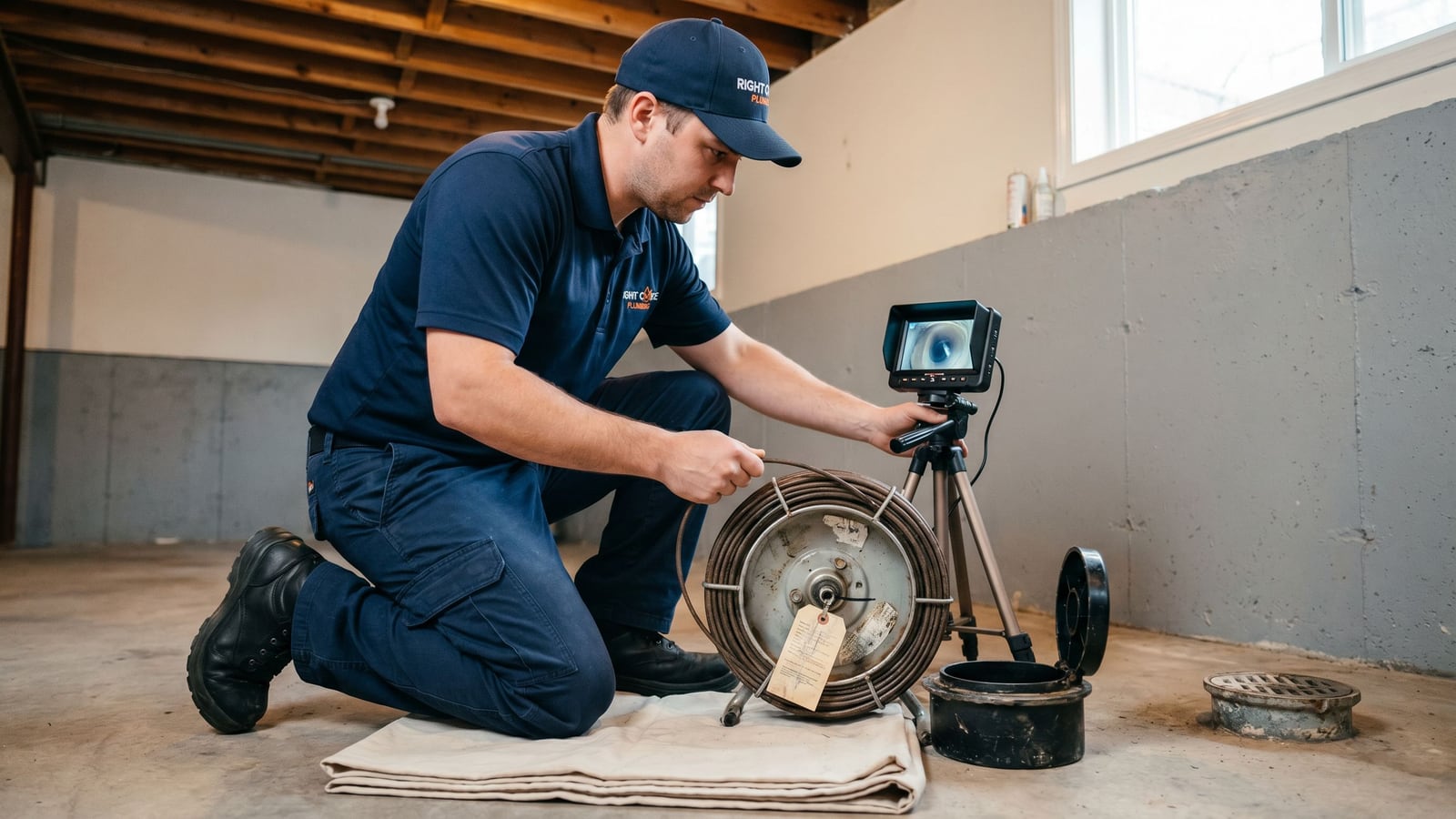
Thinking about a sewer camera inspection in Calgary, or wondering whether you need a sewer scope before buying a house? Below we walk through what the camera shows on the screen, the warning signs that should trigger a scope, who pays for what under City of Calgary rules, and what a sewer camera inspection in Calgary actually costs in 2026, so you know within five minutes whether to pick up the phone.
A sewer line is the single most expensive part of a Calgary home that nobody can see. The pipe runs from your basement, under the footing, across the yard, and ties into the City main beneath the street. When it fails, it fails silently. The kitchen drains fine right up until the night it backs up into the basement, and by then you are facing a four or five figure repair on a pipe you never knew was at risk.
We scope and repair sewer laterals every week across Calgary, Edmonton, and Greater Vancouver, so the patterns below come straight off the camera monitor: root mats in clay tile joints, bellied lines holding water, and corroded cast iron in pre-war inner-city homes. Whether you are a homeowner chasing a recurring backup or a buyer about to waive conditions, here is how to read what the camera finds.
Key Takeaways
- A sewer camera inspection in Calgary (also called a sewer scope) usually runs $250 to $600, with most standard residential scopes around $350 to $450. That is a fraction of the $8,000 to $30,000 a missed sewer line repair or replacement can cost.
- The scope is the only way to see the buried lateral. A standard home inspection does not cover it, which is why a sewer scope before buying a house is the most cost effective due-diligence step on an older Calgary property.
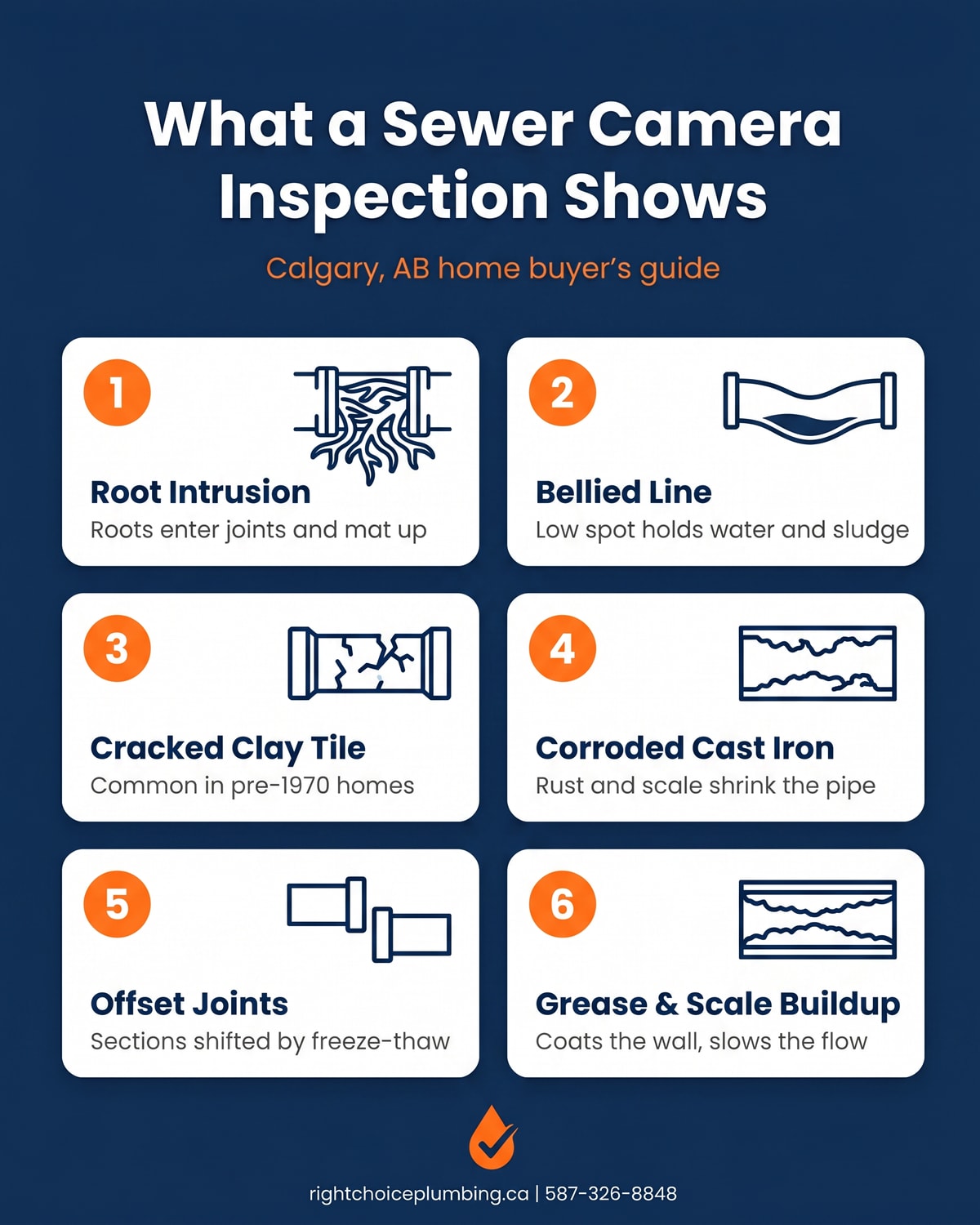
- The defects we find most in Calgary are root intrusion at pipe joints, offset joints and bellied lines from freeze-thaw ground movement, and cracked clay tile or corroded cast iron in homes built before the 1970s.
- In Calgary the homeowner owns the sewer lateral all the way from the house to the property line. The City only maintains the main under the street, so any defect on your side is your bill.
- If you see two or more warning signs (repeat backups, gurgling drains, sewer smell, a sunken patch in the yard), or you are buying a pre-1980 home with mature trees, book the scope before you commit. Either the footage comes back clean or it becomes the number you negotiate against.
What a sewer camera inspection in Calgary actually shows
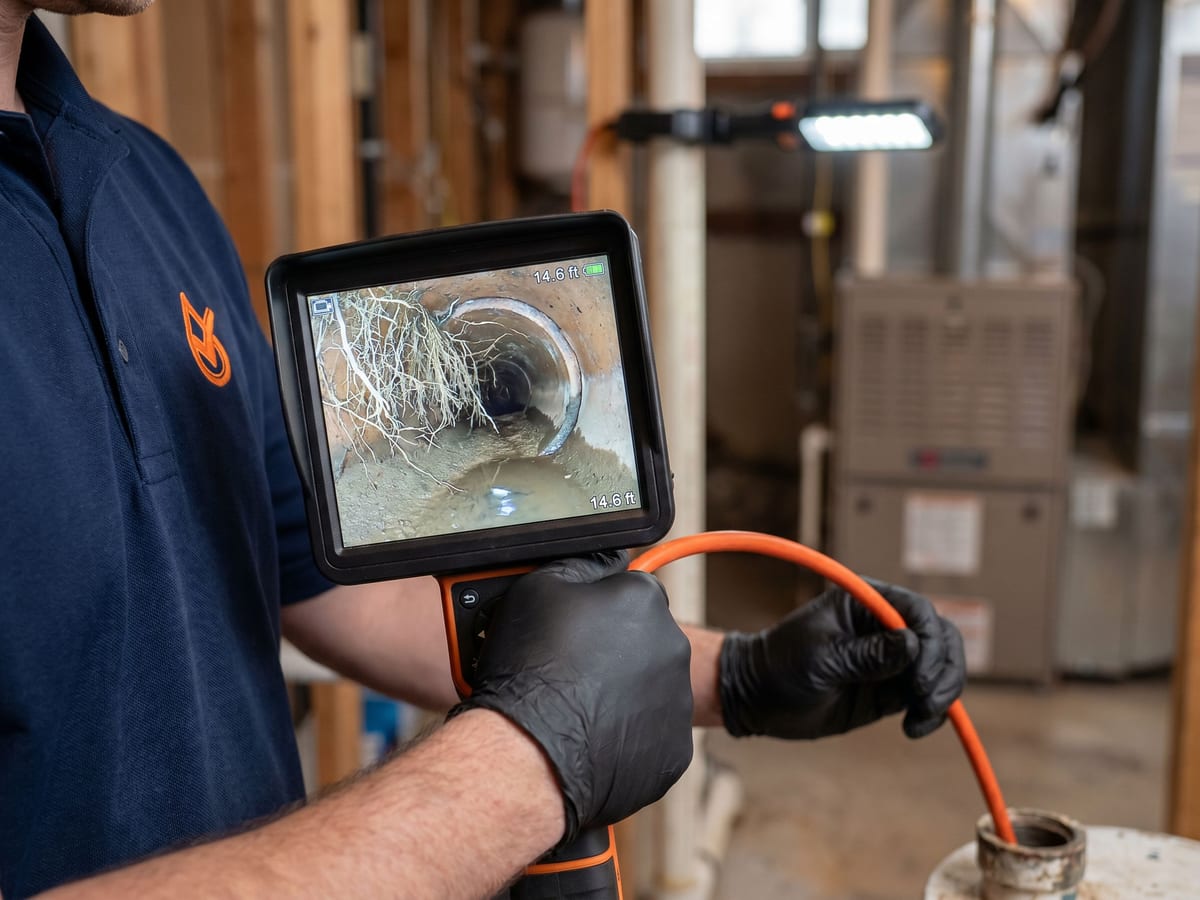
A sewer camera inspection (sewer scope, drain scope, CCTV inspection) is a self-levelling waterproof camera on a flexible push-reel that we feed into your main sewer line through a cleanout. The camera sends live video to a monitor so we can watch the inside of the pipe travel from your basement out to the City connection. You leave the visit with a recorded video and a written report of what the line is made of, what shape it is in, and where any defect sits.
How the scope works
We locate the main cleanout (usually in the basement near where the water service enters, often beside the main shut-off), pull the cap, and feed the camera down the line. As the head travels we read the pipe wall, the joints, and the flow. A sonde transmitter in the camera head lets us pinpoint the exact spot and depth of any problem from the surface above, so if a repair is needed we already know where to dig. Most scopes take 40 to 75 minutes depending on access.
What the camera finds
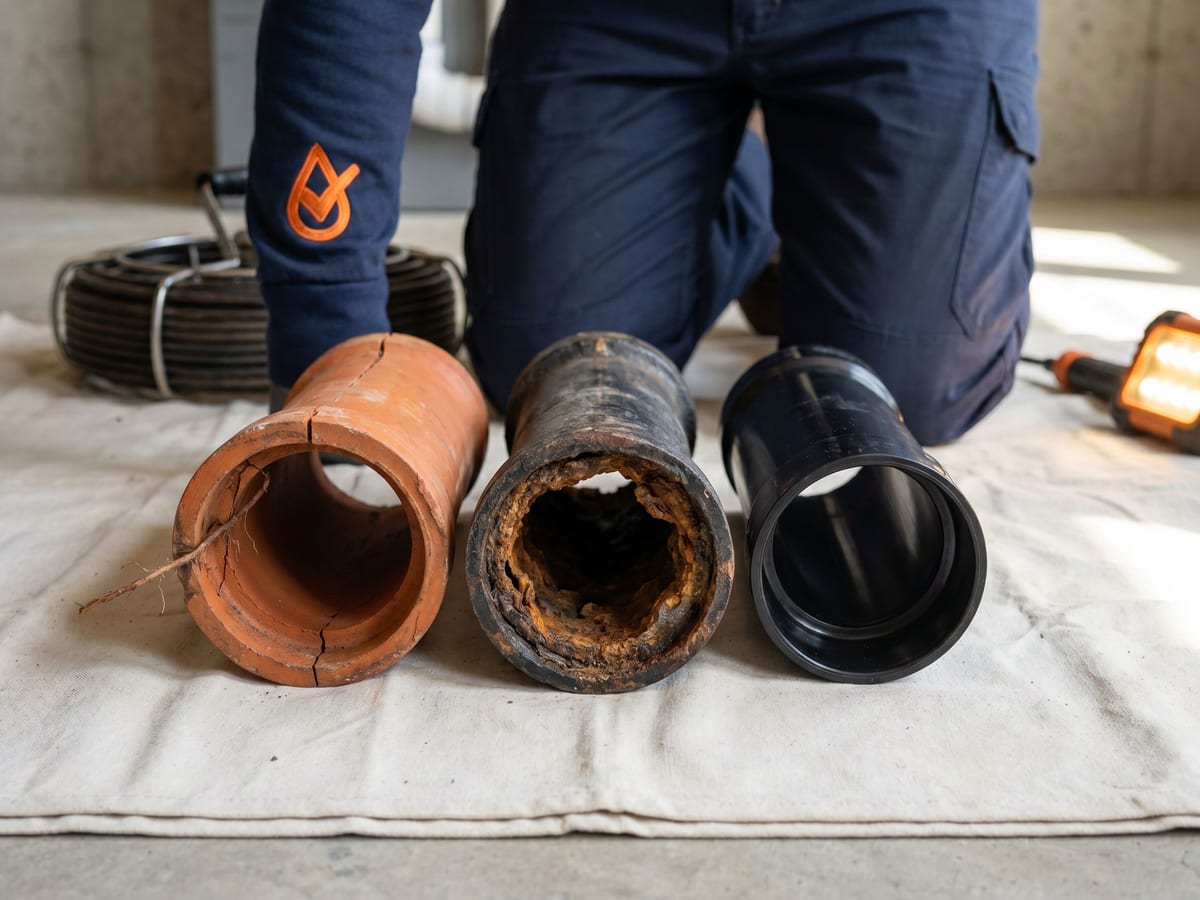
This is where a sewer scope earns its keep. On the monitor we can clearly identify root intrusion, cracked or fractured pipe, collapsed sections, offset joints, bellied lines (low spots that hold standing water), grease and scale buildup, improper slope, construction debris, and the pipe material itself. We can tell clay tile from cast iron from modern ABS at a glance, which matters more than most homeowners realise, because the material tells you how much life the line has left.
What a scope cannot tell you
A scope is a visual tool, so it has limits. It will not see through standing water in a deep belly, and it stops where it loses access (a hard transition, a full blockage, or the City tap). It also does not put a price on the fix by itself. We read the footage, confirm the material and depth, and only then quote the repair. Honest scoping means being clear about what we can see and what we cannot.
The Calgary-specific angle
Calgary is hard on sewer laterals for three local reasons. The freeze-thaw cycle and expansive clay soils heave and settle the ground every year, which shifts pipe joints and creates bellies. The mature elm and poplar canopy that lines so many inner-city boulevards sends roots straight to the easiest water source on the lot, which is a leaky sewer joint. And a huge share of homes in Bridgeland, Inglewood, Killarney, Renfrew, and Mount Pleasant were built when clay tile and cast iron were standard. Stack those three together and you understand why we pull so much root mass out of Calgary lines.
Why Calgary sewer lines fail (the why before the what)
Understanding how these lines fail makes the camera footage easy to read. Almost every failed Calgary lateral we open up has at least two of the following going on at once.
Root intrusion
A thirsty tree root finds a hairline gap at a pipe joint, slips through, and grows into a dense mat inside the pipe. The mat slows flow, catches grease and paper, and eventually chokes the line. Calgary's elm-lined streets make root intrusion the number one defect we see on camera, and it almost always starts at a joint, which is why old clay tile (lots of joints, none watertight after 60 years) suffers the most.
Freeze-thaw movement, offset joints, and bellied lines
Calgary's ground does not sit still. Seasonal frost and the shrink-swell of clay soil heave and drop the earth around your lateral year after year. That movement pulls joints apart (an offset joint, where two sections no longer line up) and sags sections into a low spot. A bellied line holds water and sludge instead of draining cleanly, so solids drop out and clogs become a pattern rather than a one-off. A belly shows up instantly on screen: the picture goes from a clean pipe wall to a pool of standing water that does not move.
Pipe material and age: clay tile, cast iron, and Orangeburg
The vintage of the home tells most of the story before we even drop the camera. Homes built before the early 1970s commonly have vitrified clay tile (strong against crushing, weak at every joint) or cast iron (durable but rusts and scales from the inside until the bore shrinks). Some 1950s and 1960s homes used Orangeburg, a tar-impregnated fibre pipe that delaminates and goes oval with age. Homes built from the 1980s on generally have ABS or PVC, which is smooth, glued, and far more forgiving. Problems in newer ABS are usually slope or workmanship, not age.
Grease, scale, and bad transitions
Decades of grease and soap coat the pipe wall and shrink the usable diameter, especially in cast iron. We also find clumsy past repairs: mismatched pipe types butted together, sharp transitions that snag debris, and saddle connections that were never done cleanly. None of this is visible from inside the house. All of it shows up on camera the moment the head passes through.
When you need a sewer camera inspection in Calgary
Reading any one sign on its own is not always a call to action. The decision usually tips when two or more show up together, or when you are about to spend money on the house.
1. You are buying a house (especially anything pre-1980)
This is the textbook case. A standard home inspection covers the visible, accessible parts of a house and excludes underground utilities, so the sewer lateral is never part of it. Under the InterNACHI Standards of Practice that most Alberta home inspectors follow, inspectors are not required to inspect underground items at all. A sewer scope before buying a house closes that gap. On a pre-1980 home with clay tile and a few big trees out front, scoping the line before you waive conditions is the cheapest insurance you will ever buy.
2. Recurring backups or repeat clogs
If the main line backs up more than once, or a plumber has snaked it more than once in a year, the clog is a symptom, not the disease. Roots, a belly, or an offset joint will keep catching debris until the underlying defect is fixed. A scope finds the actual cause so you stop paying to clear the same clog twice.
3. Slow drains and gurgling across the whole house
One slow sink is a local clog. Slow drains everywhere, plus gurgling toilets or a basement floor drain that burps when the washing machine empties, points at the main line. That is a scope, not a plunger.
4. Sewer smell or sewage in the basement
A persistent sewer odour, or any sewage backing up through the lowest floor drain, means the line is compromised or blocked. Scope it to find out whether you are dealing with a clog, a crack letting in soil, or a collapse.
5. A sinkhole, soft spot, or lush green stripe in the yard
A leaking sewer line feeds the soil above it. A sunken patch, a soft muddy area, or a strip of grass greener than the rest of the lawn often traces the path of a cracked lateral leaking underground.
6. After landscaping, renovations, or a basement development
Heavy equipment, new tree planting, regrading, or adding a basement bathroom can all stress or shift a buried line. Before you add fixtures and load, confirm the existing lateral can handle it and has the slope to drain. We would rather scope first than have you finish a basement that ties into a failing line.
What a sewer camera inspection costs in Calgary in 2026
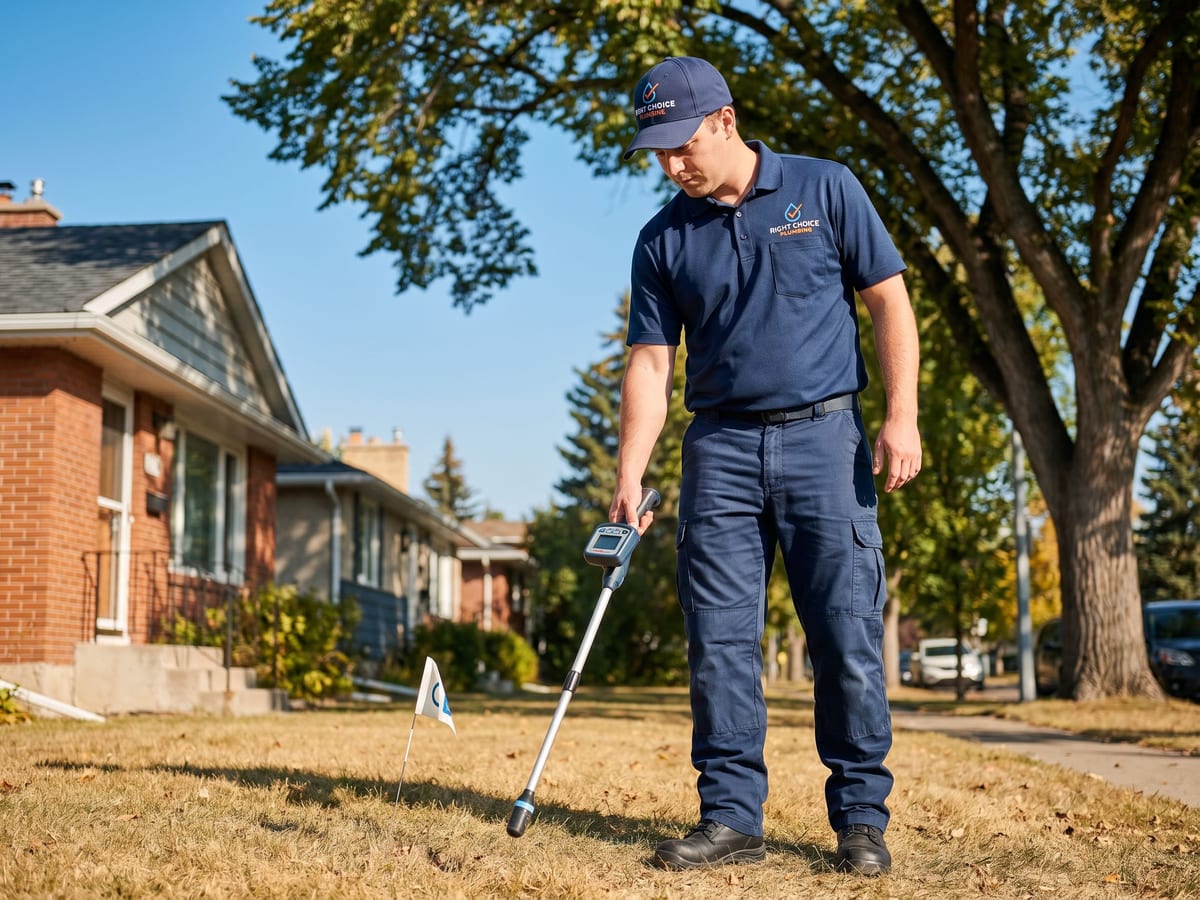
Here are the real numbers. In 2026 a sewer scope in Calgary generally costs between $250 and $600, with a standard residential scope through an accessible cleanout around $350 to $450. Bundled as an add-on to a larger drainage visit it can come in lower. The single biggest variable is access.
Standalone scope vs add-on
A dedicated scope (camera, locate, video, and written report) is priced as its own job. If we are already on site for drain cleaning and the line is open, adding a camera pass costs less because the truck and the technician are already there. Either way you get the recorded footage.
Access is the price lever
A clear, accessible main cleanout keeps the job quick and at the low end. With no usable cleanout, we access the line through a pulled toilet or a roof vent stack, which adds time and usually a flat add-on fee. Older Calgary homes are the ones most likely to have buried, painted-over, or missing cleanouts, so it is worth checking before you book.
What else moves the number
Line length, depth, the amount of standing water or debris we push through to get a clean picture, and whether you want the defect located and marked on the surface all factor in. A short inner-city lateral scopes faster than a long line on a large lot.
Who actually pays: you own the lateral
This is the part Calgary homeowners are most often surprised by. Under City rules, the homeowner is responsible for the sewer service connection from the property line to the house. The City of Calgary maintains the main beneath the street, but the lateral on your side, including the portion buried out to the property line, is yours to repair at your expense. So when a scope finds a problem, the repair bill is the homeowner's, which is exactly why catching it before you buy matters so much.
Repair vs replace? Reading the camera footage
Once we have the footage, the decision usually sorts into one of two buckets.
A spot repair makes sense when: the line is mostly intact ABS or PVC, the defect is isolated to one joint or one short section, the clog is roots or grease that came clear, the pipe material has good life left, and fixing the one spot costs meaningfully less than replacing the whole run. We dig the marked spot, cut out the bad section, and tie in new pipe.
A full replacement makes sense when: the home is pre-1970 with original clay tile or Orangeburg, multiple joints are offset or rooted, the camera shows a belly or collapse, the cast iron is scaled down to a fraction of its bore, or past patch repairs have left a Frankenstein line. In those cases we quote open-cut or trenchless replacement with the footage right there on the screen so you can see what you are paying to fix.
What a scope and repair looks like in Calgary and Edmonton
A standard scope is a single appointment: locate the cleanout, run the camera through the full lateral, capture the video, mark any defect on the surface, and walk you through the report. Most homes are done inside an hour. If the line is clear and you only wanted to know that before waiving conditions, that is the whole job.
If the camera finds a problem, the repair is a separate, quoted job. A spot repair is typically a one to two day excavation at the marked location. A full lateral replacement is a larger project that depends on depth, length, and whether we go open-cut or trenchless, and it requires the right City permits, which we pull and coordinate with the inspector. We run the same sewer line repair workflow across both provinces, and the older the housing stock the more often it comes up. Inner-city Calgary keeps our cameras busy, and so does Edmonton's pre-war core in Strathcona, Glenora, Riverdale, and the Highlands. Whether you need a Calgary plumber for a pre-purchase scope or an Edmonton plumber for a recurring backup, the crew, the camera, and the workmanship warranty are the same. When you are ready, we are one call away, and we are Right Choice Plumbing.
FAQ
Is a sewer scope included in a standard home inspection in Calgary?
No. A standard home inspection covers the visible, accessible systems of a house and excludes underground utilities, so the buried sewer lateral is never part of it. A sewer scope is a separate service you request and book on its own. On older Calgary homes it is the most financially important add-on you can arrange, because a failed line can stay silent until the first backup.
How much does a sewer camera inspection cost in Calgary?
In 2026 most scopes in Calgary run $250 to $600, with a standard inspection through an accessible cleanout around $350 to $450. Difficult access (no cleanout, requiring a pulled toilet or roof-vent entry) adds a flat fee. That is small money against the $8,000 to $30,000 a sewer line repair or replacement can cost, which is what makes a pre-purchase scope worth it.
Should I get a sewer scope before buying a house?
Yes, especially for any home built before 1980 or any property with mature trees near the line. Standard inspections skip the lateral, and the buyer inherits the repair bill after possession. A scope before you waive conditions confirms the line is sound or hands you the footage to negotiate a price reduction or a repair from the seller.
What does the camera actually show on the screen?
The live video shows the inside of the pipe: the material (clay tile, cast iron, or ABS), root intrusion at joints, cracks, collapsed sections, offset joints, bellied lines holding water, grease and scale buildup, and improper slope. A locator in the camera head lets us mark the exact spot and depth of any defect on the surface, so a repair can be targeted instead of guessed.
Does the City of Calgary pay to fix my sewer line?
No. The City of Calgary maintains the main sewer line under the street, but the homeowner owns and pays for the lateral from the property line to the house. Any defect the camera finds on your side of the property line is your responsibility, which is why scoping early and budgeting for repairs is so important on older properties.
How long does a sewer camera inspection take?
A typical scope takes 40 to 75 minutes. With a clean, accessible cleanout it is closer to 40 minutes. If we access the line through a pulled toilet or the roof vent stack, budget a little longer. You get the recorded video and a written summary the same day in most cases.
The bottom line on a sewer camera inspection in Calgary
So, do you need a sewer camera inspection in Calgary? If you are buying an older home, or your line backs up more than once, the answer is almost always yes. The scope is the only honest way to see a buried lateral, and for $250 to $600 it either confirms the line is sound or stops you inheriting a five-figure repair you never agreed to.
Walk through the warning signs, check whether the home is pre-1980, look for mature trees over the line, and if two or more boxes get ticked, scope it before you commit or before you snake that recurring clog one more time. When you want the camera in the line and the footage on the screen, we are here day or night, every day of the week, at 587-326-8848.
You might also like
Related plumbing reads
- Wet Basement During Heavy Rain in North Vancouver? 5 Perimeter Drain Warning Signs To Act On This Fall Wet basement during heavy rain? Here are the 5 perimeter drain warning signs every North Vancouver homeowner should act on before the fall rainy season hits.
- How Long Does a Hot Water Tank Last in a Vancouver Home? 7 Signs It Is Time to Replace Yours How long does a hot water tank last in Vancouver? Most last 8 to 12 years. Here are the 7 signs it is time to replace, plus how to read your tank's age sticker.
Latest from the blog
Recent posts
Drain Cleaning
Slow Kitchen Drain That Won't Clear? When Snaking Works and When You Need Hydro-Jetting (Edmonton Plumber Explains)
Slow kitchen drain won't clear, even after snaking? Here is the drain snake vs hydro jet call an Edmonton plumber makes, plus real 2026 costs for each.
Need a plumber for this?
Skip the DIY rabbit hole - our licensed Vancouver plumbers cover Greater Vancouver with same-day appointments and 24/7 emergency service. Workmanship warranty on every job.