
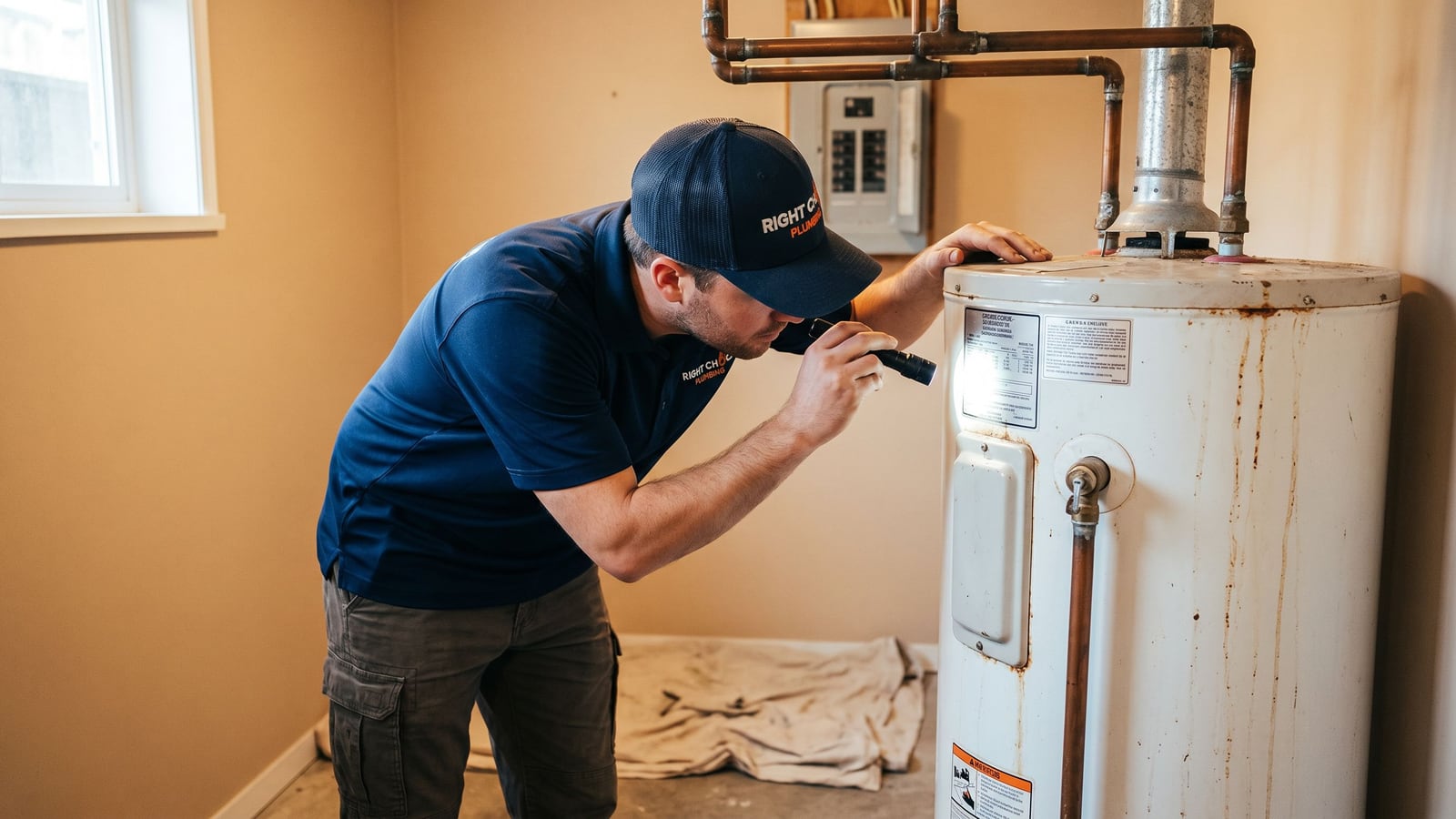
Wondering how long does a hot water tank last in your Vancouver home, and whether the rumbling noises, slow recovery in the morning, or that faint rusty tinge in the hot tap are early warnings? This guide walks you through realistic hot water tank lifespan in Vancouver, the seven signs that mean it is time to replace, how to decode the manufacture date right off your tank, and when a quick repair will actually save you money versus when it is throwing good cash at a tank that is already done.
Most Vancouver homes have a 50 gallon gas or electric hot water tank tucked into a basement utility room or a garage closet. They are out of sight, out of mind, until they aren't. The good news: tanks rarely fail without warning. The bad news: most homeowners ignore the warning signs until the unit is dripping onto the basement slab and the laundry room is starting to smell like wet drywall.
We replace and repair hot water tanks every week across Vancouver, North Vancouver, West Vancouver, Burnaby, Richmond, and Coquitlam, so the patterns below are pulled straight from on-the-job experience in BC homes. Read it once, walk down to your tank, and you will know within five minutes whether you have time on your side or whether you should be booking a hot water tank repair or a hot water tank replacement today.
Key Takeaways
- A standard gas hot water tank in Vancouver lasts 8 to 12 years. Electric tanks usually last 10 to 15 years. Tankless units typically last 15 to 20 years with proper maintenance.
- Vancouver's exceptionally soft water (about 0.3 grains per gallon, roughly 5 ppm of calcium carbonate from the Capilano, Seymour, and Coquitlam reservoirs) is gentler on tanks than most Canadian cities, but trace minerals still build sediment over time.
- The single biggest indicator that your tank is finished is age plus rusty or cloudy hot water. The interior glass lining cannot be repaired once it corrodes, so when both signs are present, replace the unit.
- Rumbling, popping, or banging noises mean sediment is baked onto the bottom of the tank. Annual flushing prevents it. Once you can hear it, the tank is on borrowed time.
- A like-for-like residential replacement in Vancouver takes 2 to 4 hours when done by a licensed plumber, includes a fresh expansion tank and T&P relief valve, and is backed by both manufacturer and workmanship warranty.

How long does a hot water tank last in a Vancouver home?
The honest answer: it depends on the type of tank, the quality of the original install, and whether anyone has done a single drop of maintenance in the last decade. Here is what we actually see in Vancouver homes.
Standard gas hot water tanks: 8 to 12 years
Atmospheric and power-vented residential gas tanks are the most common setup in Vancouver, Burnaby, and Coquitlam. The realistic service life is 8 to 12 years, with most failures clustering around year 10 to 11. The lower bound shows up in homes where the tank has never been flushed and the anode rod has never been touched. The upper bound shows up in homes where someone has flushed it once a year and replaced the anode rod once during the tank's life.
If your tank still has a working pilot, no leaks, and no rusty water in year 9 or 10, you are doing fine. Most manufacturer warranties (Rheem, Bradford White, John Wood, A.O. Smith) are 6 years, with extended 10 or 12 year warranty options. Once you are past the warranty window, every replacement part you pay for is on borrowed time.
Electric hot water tanks: 10 to 15 years
Electric hot water tanks tend to last a couple of years longer than gas because there is no gas burner, no thermocouple, and no flue venting to corrode. The trade-offs are slower recovery and higher per-litre operating costs (especially with BC Hydro's tiered rates), but the tank itself usually outlives a gas equivalent.
The most common failures on electric tanks are heating elements (lower element first, almost always) and thermostats. Both are repairable. Once the steel tank itself starts leaking, though, the math flips and replacement becomes the only sensible call. We talk you through the breakeven below.
Tankless water heaters: 15 to 20 years
Tankless gas units (Navien, Rinnai, Noritz, Bosch) heat water on demand, so there is no stored water to corrode the inside of a steel tank. With annual descaling, a quality tankless unit will routinely hit 15 to 20 years, and FortisBC offers rebates of up to $1,000 for switching from a tank to a high-efficiency tankless during a replacement. We carry and install all the major tankless brands. If your existing tank is past 10 years and the venting and gas line allow it, the upgrade is usually worth running the numbers on.
Why Vancouver tanks slightly outlast the national average
Metro Vancouver tap water is sourced from three pristine mountain reservoirs (Capilano, Seymour, and Coquitlam) and tests at roughly 0.3 grains per gallon of hardness, or about 5 ppm of calcium carbonate. That is among the softest municipal water in North America, comparable to Seattle and dramatically softer than Calgary, Edmonton, or Winnipeg, where water hardness can exceed 200 mg/L.
Soft water means scale forms slower on the bottom of your tank and on heating elements, which is why a well-maintained Vancouver tank will sometimes squeak past the 12 year mark. Do not get cocky, though. Even soft water still concentrates trace minerals as it heats, and Vancouver's relatively low pH and low mineral content can be slightly corrosive to copper supply lines and the steel tank lining itself. The tank still ages. It just ages a touch slower than it would in a hard-water city.
What actually shortens hot water tank lifespan
Once you understand what kills tanks, the seven signs below make a lot more sense.
Sediment buildup (yes, even in soft water)
Every time water is heated, dissolved minerals drop out of solution and settle at the bottom of the tank. In Vancouver this happens slower than in hard-water cities, but it still happens. After a few years that sediment forms a baked-on layer that acts like a thermal blanket between the burner and the water in a gas tank, or coats the lower heating element in an electric tank. The result: longer recovery times, higher gas or hydro bills, and eventually the rumbling or popping sound you hear right before the tank fails.
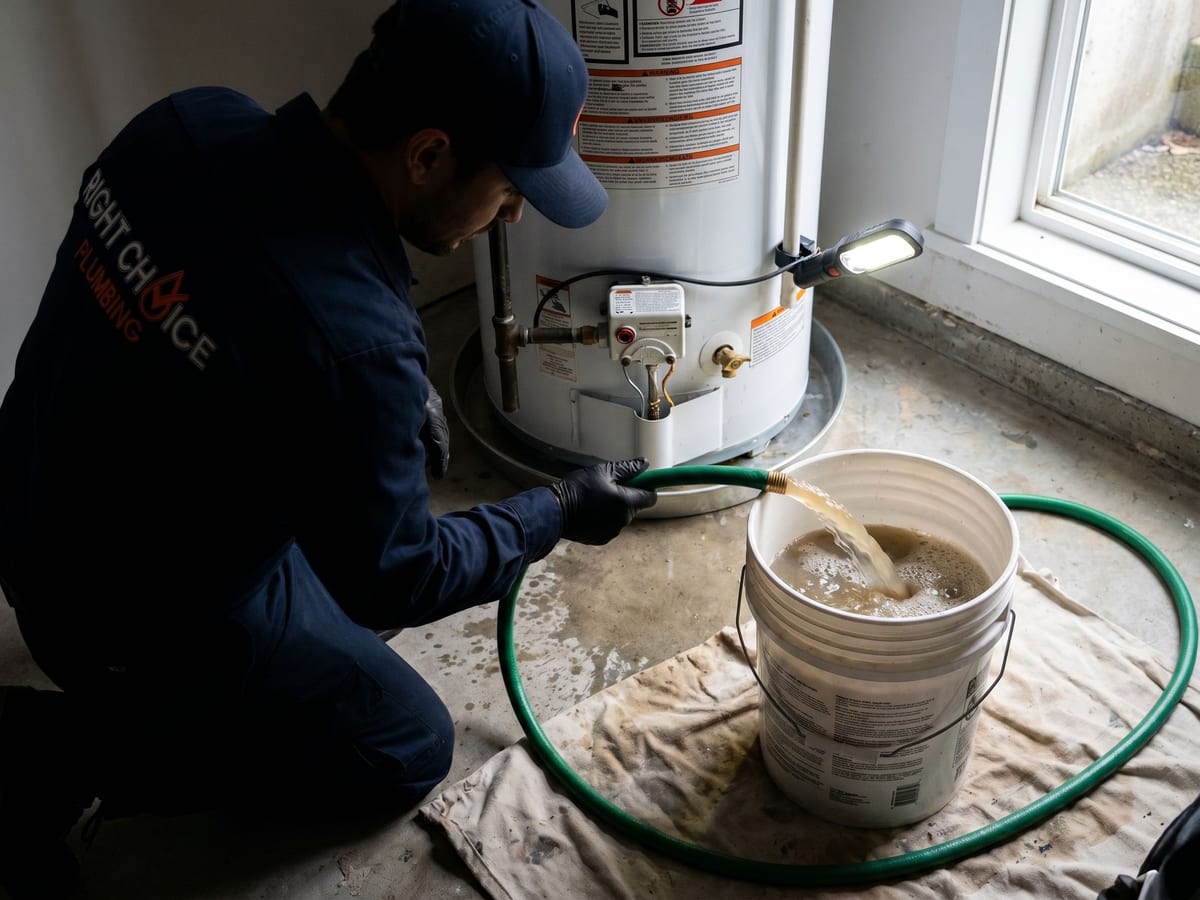
The fix is simple: drain a few litres from the tank's bottom valve once a year until the water runs clear. Most homeowners never do it. Most tanks suffer for it.
The anode rod (and why nobody checks it)
The anode rod is a sacrificial metal rod (usually magnesium or aluminum) threaded into the top of the tank. Through a slow electrochemical reaction, the rod corrodes so the steel tank does not. Once the rod is more than half eaten away, the tank's glass-lined steel becomes the next target, and from that point most tanks fail within one to three years.
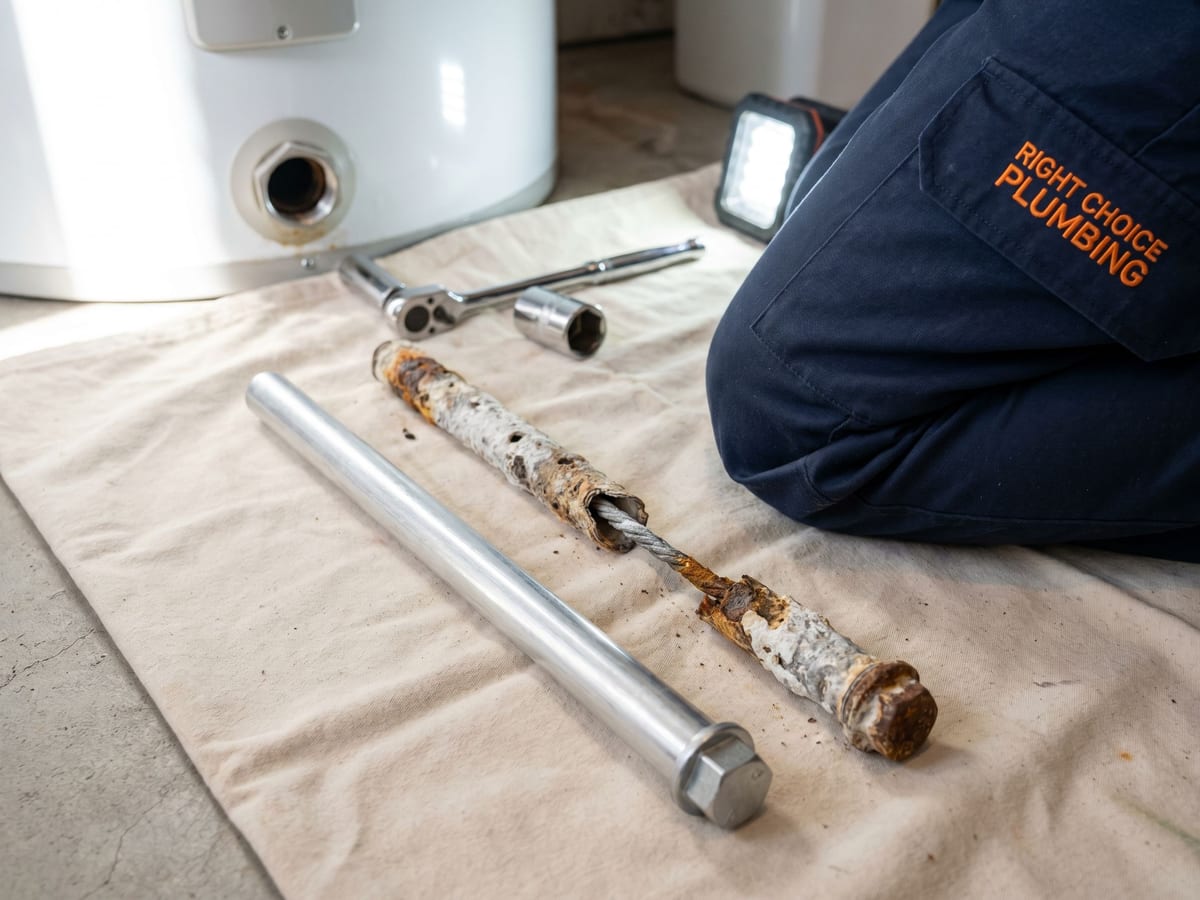
Manufacturers recommend inspecting the anode every 3 to 5 years and replacing it once it is more than 50% depleted. We can count on one hand the number of Vancouver homeowners who have had this done. If you have a tank in year 6 to 8 and you want to push it past year 10, replacing the anode is the one job with the best odds of getting you there. We include anode-rod inspection on every hot water tank repair call.
Water pressure and the missing pressure regulator
If your incoming water pressure is over 80 PSI (the BC code maximum for residential systems), the temperature and pressure relief valve on your tank will leak, the tank itself fatigues faster, and your supply lines start to weep at fittings. A surprising number of older Vancouver homes either never had a pressure-reducing valve installed or have one that is stuck wide open. We check incoming PSI on every hot water tank service call. If yours is high, the fix is a $150-ish PRV swap that can add years to every fixture in the house.
Installation quality (the silent killer)
A poorly installed tank with an undersized gas line, the wrong dielectric nipples, no expansion tank on a closed system, kinked supply lines, or a sloppy T&P discharge will fail in year 6 or 7 instead of year 10. We see it constantly, especially on tanks installed by general contractors during a renovation rather than by a licensed plumbing or gasfitting contractor. If your tank is younger than 8 years and is acting up, the install is often the root cause, not the tank itself.
7 signs it is time to replace your hot water tank
Reading the signs separately is one thing. The decision to replace is usually triggered when two or more show up at once. Walk down to your tank with this list in hand.
1. Your tank is over 10 years old
Age beats every other variable. If your tank is over 10 years old and you are seeing any of the next six signs, replace rather than repair. The math almost never works on a tank past warranty. Skip ahead to the section below to read the manufacture date right off the data plate if you do not already know it.
2. Hot water comes out rusty or cloudy
Run the hot tap into a clean white container for 30 seconds. If the water looks tinted brown, orange, or cloudy (and the cold tap looks clear), the inside lining of your tank is corroding. The lining cannot be repaired. The rust will not get better. Replace the tank.
A few caveats: brand new municipal main work or hydrant flushing in your neighbourhood can briefly cause both hot and cold to run discoloured. If only the hot is off, it is the tank.
3. Rumbling, popping, or banging noises
A healthy tank is quiet. A tank that pops, rumbles, or sounds like a kettle on a boil has a thick layer of baked-on sediment trapping pockets of water that boil and burst as the burner fires or the element heats up. In year 4 to 6, this is sometimes recoverable with a thorough flush plus a power-vac of the bottom of the tank. In year 9 or 10, it is the start of the death rattle. Once the noise becomes a daily soundtrack, plan the replacement.
4. Water pooling or dripping at the base
Any visible water around the base of the tank, on top of the drain pan, or running down the side from a fitting is a problem. There are two flavours.
If the water is coming from a fitting, the T&P relief valve, the drain valve, or a supply union, it is usually a repair. We tighten, replace gaskets, swap the relief valve, you are back in business.
If the water is seeping out of the body of the tank itself (a pinhole near the bottom, a streak running down from below the jacket), the steel has corroded through. There is no patch, no sealant, no fix. Shut the cold supply off, kill the gas or breaker, and call us. A leaking tank can dump 50 gallons across the floor in under an hour, and Vancouver insurance claims for water damage from failed hot water tanks are not cheap.
5. Hot water runs out faster than it used to
If a 10 minute shower used to be fine and now you are running cold by minute 5, your tank is losing capacity. On a gas tank, sediment is insulating the burner from the water column. On an electric tank, the lower element is either coated in scale, partially failed, or its thermostat is shutting down early. We can test elements, swap thermostats, descale, or in older tanks recommend replacement. The decision usually comes down to age plus signs 2 and 3.
6. Pilot keeps going out (gas) or breaker keeps tripping (electric)
A failed thermocouple, a dirty pilot assembly, or a faulty gas valve will shut a gas tank down repeatedly. On an electric tank, a shorted element or a corroded element terminal will trip the breaker.
If the tank is under 8 years old, a thermocouple, gas valve, or element swap is genuinely worth it (typical bench rate plus the part). If the tank is past 10 years, you are throwing parts at a unit that is already on its way out. We will tell you straight which side of that line you are on.
7. Your gas or hydro bill is climbing without explanation
A hot water tank that has lost efficiency from sediment, a failing element, or a corroded burner assembly will burn 15 to 30% more energy to deliver the same hot water. If your FortisBC or BC Hydro bills have crept up steadily over the last 12 months and nothing else has changed in your home, your tank is a likely suspect. This sign rarely shows up alone, so look for it alongside one of the other six.
How to read the age sticker on your hot water tank
The fastest way to know if your tank is on borrowed time is to read the manufacture date right off the data plate. The plate is a foil or plastic sticker glued to the upper third of the tank, usually on the front or the side, and it lists model, serial, BTU input (gas) or wattage (electric), and date. Some plates print the manufacture date in plain text. Most encode it inside the serial number.
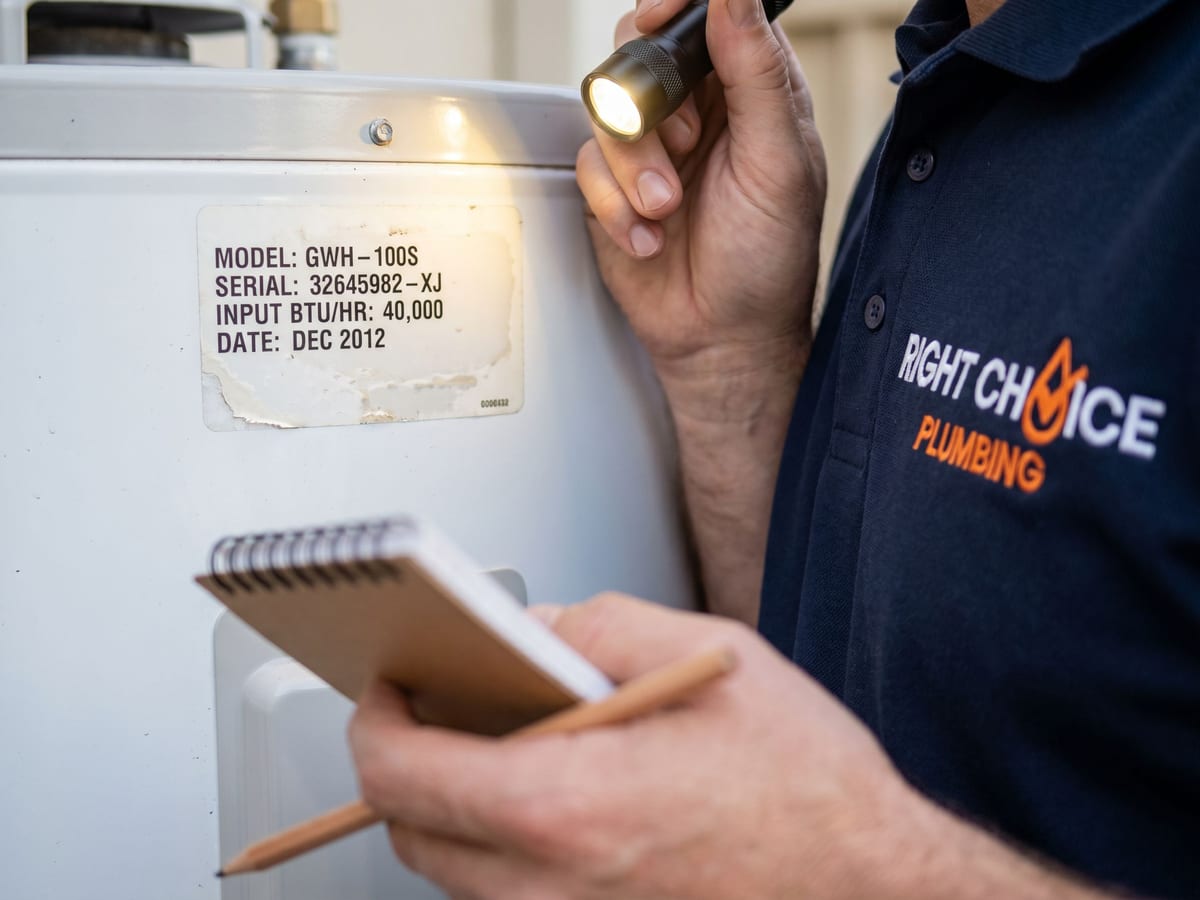
Here are the most common decoding rules in Vancouver homes.
Rheem, Ruud, Richmond, GE
Rheem-family tanks use a 10-digit serial number. The first two digits are the month, the next two digits are the year. Examples: a serial starting with 0720 was made in July 2020. A serial starting with 1219 was made in December 2019. Some older models reverse the order or insert letters before the date code, but the four-digit MMYY block is almost always the leading numeric pair you see.
Bradford White (and JetGlas)
Bradford White uses a two-letter date code. The first letter is the year (with a 20-year cycle, so A repeats every 20 years), the second letter is the month, and the letters I and O are skipped to avoid confusion with 1 and 0. The most common modern years: A = 2004 or 2024, B = 2005 or 2025, C = 2006 or 2026, D = 2007, E = 2008, F = 2009, G = 2010, H = 2011, J = 2012, K = 2013, L = 2014, M = 2015, N = 2016, P = 2017, S = 2018, T = 2019, W = 2020, X = 2021, Y = 2022, Z = 2023. Months: A = January through M = December (skipping I).
If your serial starts MH... the tank is from August 2015. XB... means February 2021. Almost always the surrounding context (other equipment vintage, install records) tells you which 20-year cycle you are on.
John Wood, GSW, Giant, Superflu
These Canadian-built tanks use the first four digits of the serial number as YYWW. The first two are the year, the next two are the week of that year. A serial starting 2308 was built in week 8 (late February) of 2023. 1442 was built in week 42 (late October) of 2014.
A.O. Smith, State, Reliance, Kenmore (most)
A.O. Smith and the brands they manufacture use the same YYWW format as John Wood. The first two digits are the year, the next two are the week. A Kenmore model number starting with 153 is actually a Rheem-built tank and uses MMYY instead, so check the model prefix first.
If you cannot find or read the data plate, snap a phone photo of the entire label and call us. We can usually decode any residential tank in Greater Vancouver from a clear photo alone.
Repair or replace? When each makes sense
Once you know the age and the symptom, the decision usually falls neatly into one of two buckets.
Repair makes sense when: the tank is under 8 years old, the leak is from a fitting (not the tank body), the issue is a single component (thermocouple, gas valve, element, thermostat, T&P valve), and the repair quote is meaningfully less than 50% of a replacement.
Replace makes sense when: the tank is over 10 years old, the hot water is rusty or cloudy, the tank body itself is leaking, two or more of the seven signs above are present, or the repair quote is approaching half the cost of a new tank. We will tell you which one you are looking at on the spot, with a clear quote on each option, before any work starts. If you want a second opinion, we are happy to be the first or the second call.
What replacement looks like in Vancouver
A straightforward like-for-like residential hot water tank replacement in Vancouver, North Vancouver, Burnaby, or Coquitlam takes 2 to 4 hours from arrival to hot water on tap. The licensed plumber drains and removes the old tank, hauls it away, sets the new tank on a fresh drip pan, makes up the supply lines (usually fresh dielectric nipples plus copper or braided stainless), installs a new T&P relief valve, sets the gas or electrical, vents to code, fills, purges air, lights, sets the thermostat to 60 C / 140 F, and pressure-tests every joint.
For tankless conversions, longer venting, gas line upsizing, or fuel conversions (electric to gas, gas to electric), plan on 4 to 8 hours and a permit. We handle the permit, the FortisBC rebate paperwork on tankless upgrades, and the safety inspection. Every install is backed by our workmanship warranty plus the full manufacturer warranty on the tank itself.
If you want to know what a real installer looks like on the ground in your city, the plumber Vancouver team that handles downtown, the West Side, and the East Van neighbourhoods is the same crew that covers the Tri-Cities and the Burnaby plumber corridor: same uniforms, same vans, same workmanship warranty. We are Right Choice Plumbing, and hot water is what we do every day.
FAQ
How often should I flush my hot water tank in Vancouver?
Once a year is the standard for Vancouver and the rest of Metro Vancouver, where the municipal water is very soft. Homes on well water (parts of Surrey, Langley, or rural Coquitlam) or homes with older galvanized supply lines should flush every 6 months. Pop the bottom drain valve, run a few litres through a garden hose into a bucket, and you will see exactly how much sediment your tank is carrying.
Is a leaking hot water tank dangerous?
A small drip from a fitting is not an emergency, but a leak from the tank body is. A failed tank can dump 50 gallons of hot water in under an hour, soak drywall, ruin flooring, and trip GFI circuits. On gas tanks, water around the base can also corrode the burner assembly and cause CO issues. If the tank body itself is leaking, kill the cold supply, kill the gas or breaker, and call a 24/7 plumber.
Can I replace my hot water tank myself in BC?
Legally, gas tank replacements in British Columbia must be done by a licensed gasfitter, and any work that touches the gas line or vent requires a Technical Safety BC permit. Electric tank swaps are technically homeowner-permitted in some jurisdictions, but the breaker work, T&P relief discharge, expansion tank sizing on closed systems, and seismic strapping (required in BC) are easy to get wrong. Insurance companies routinely deny water-damage claims when the failed tank was not professionally installed.
Do tankless hot water heaters really last 20 years in Vancouver?
Yes, with annual descaling. Vancouver's soft water actually helps, and a quality Navien, Rinnai, or Noritz unit will routinely hit 15 to 20 years when the heat exchanger is descaled once a year. Skip the descaling and you will be replacing the heat exchanger or the unit itself in year 10. We service every major tankless brand and offer annual maintenance plans.
Are there rebates for replacing my hot water tank in BC?
FortisBC offers rebates of up to $1,000 for switching from a standard gas tank to a high-efficiency tankless or condensing tank during a replacement. BC Hydro occasionally offers heat-pump water heater rebates as well. We handle the rebate paperwork on every install where the equipment qualifies.
How fast can you install a new tank if mine just failed?
Same day in most cases across Vancouver, North Vancouver, West Vancouver, Burnaby, Richmond, and Coquitlam. We carry common 40, 50, and 60 gallon gas and electric tanks (Rheem, Bradford White, John Wood, Navien, Rinnai, A.O. Smith) on the van and dispatch 24/7 for true emergencies. Call 604-330-9695 and we will give you a hard arrival window before the call ends.
The bottom line on hot water tank lifespan in Vancouver
So, how long does a hot water tank last in a Vancouver home? Most gas tanks make it 8 to 12 years, electric tanks 10 to 15, and tankless units 15 to 20 with annual maintenance. Vancouver's soft mountain water gives you a small head-start, but age, sediment, an exhausted anode rod, high incoming pressure, and a sloppy original install are still the four things that decide whether your tank dies in year 7 or year 13.
Walk down to your tank, read the date off the data plate, and run through the seven signs. If two or more are present, or if the tank is past 10 years and showing any rust or cloudy hot water, do not patch it. A proper replacement done by a licensed Vancouver plumber takes a single afternoon, comes with manufacturer and workmanship warranty, and ends the cycle of "is this the time it leaks while we are at work?". When you are ready, we are one call away at 604-330-9695, day or night, every day of the week.
Latest from the blog
Recent posts
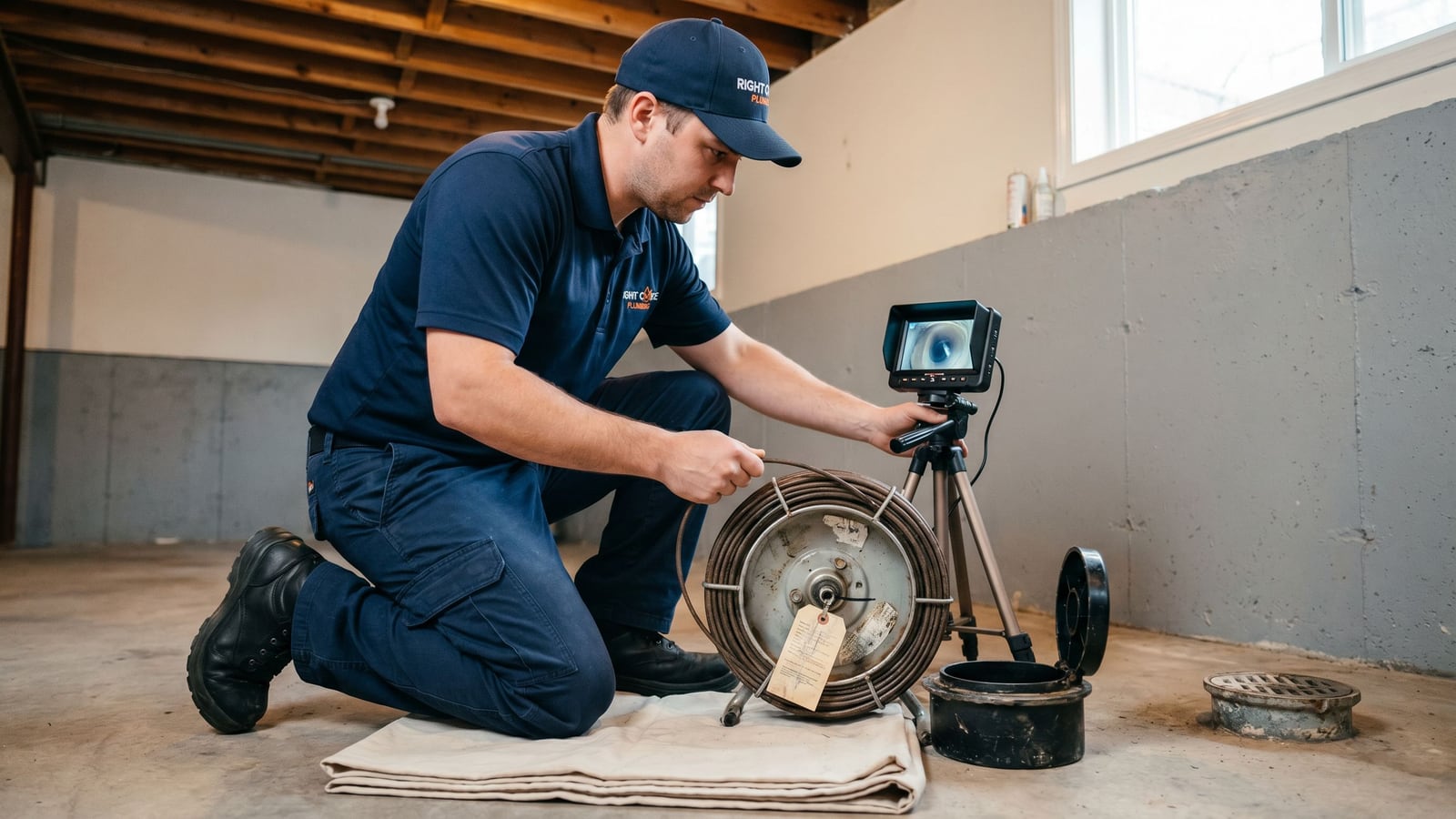
Drainage
Sewer Camera Inspection in Calgary: What It Shows, When You Need One, and What It Costs in 2026
A sewer camera inspection in Calgary reveals roots, cracks, bellies and pipe material. Here is what a sewer scope shows, when to book one, and 2026 costs.
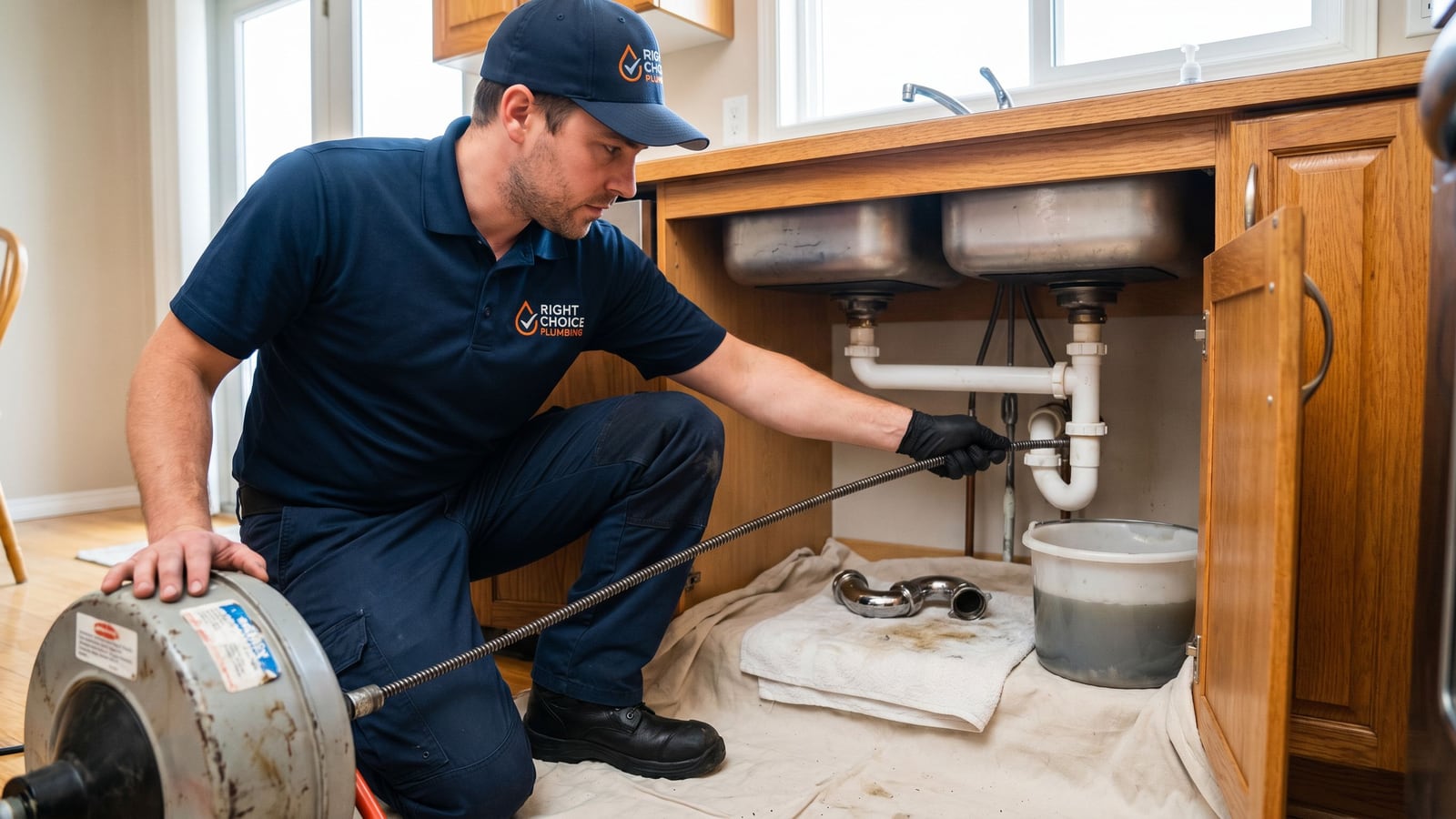
Drain Cleaning
Slow Kitchen Drain That Won't Clear? When Snaking Works and When You Need Hydro-Jetting (Edmonton Plumber Explains)
Slow kitchen drain won't clear, even after snaking? Here is the drain snake vs hydro jet call an Edmonton plumber makes, plus real 2026 costs for each.
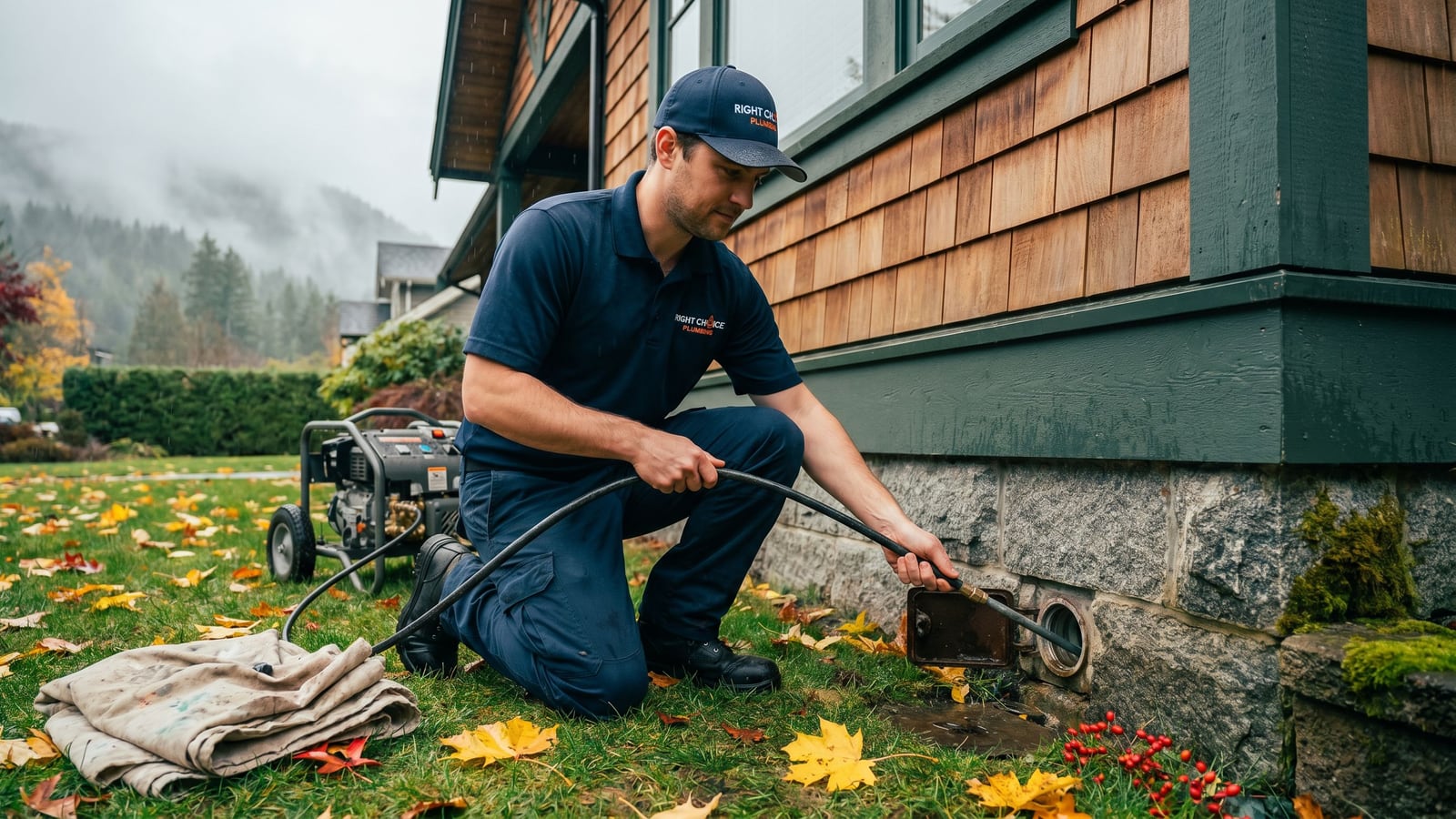
Drainage
Wet Basement During Heavy Rain in North Vancouver? 5 Perimeter Drain Warning Signs To Act On This Fall
Wet basement during heavy rain? Here are the 5 perimeter drain warning signs every North Vancouver homeowner should act on before the fall rainy season hits.
Need a plumber for this?
Skip the DIY rabbit hole - our licensed Vancouver plumbers cover Greater Vancouver with same-day appointments and 24/7 emergency service. Workmanship warranty on every job.