

Wet basement during heavy rain in North Vancouver, and wondering whether your perimeter drain is finally giving up? Below are the 5 perimeter drain warning signs every North Shore homeowner should walk their foundation looking for this fall, why North Vancouver homes fail these drains faster than the rest of Metro Vancouver, and exactly what to do this week, this month, and before the heavy rains land.
A North Vancouver home is a wet-climate home. The Environment Canada station at North Vancouver Cleveland records 170.5 days of measurable rainfall a year and 2,398.9 mm of precipitation, with November alone averaging 402.9 mm. Vancouver City Hall, by comparison, sits at about 1,285.7 mm. Your foundation is moving nearly twice the water of a downtown bungalow, and the perimeter drain (the weeping tile that wraps the footing) is the only thing between that water and your basement slab.
We service perimeter drains every week across North Vancouver, West Vancouver, Burnaby, Richmond, Coquitlam, and Vancouver, so the patterns below come straight from camera footage, hydro-jet jobs, and excavations on North Shore homes. Walk the perimeter with this list in hand and you will know within ten minutes whether you should book a perimeter drainage service before the first November storm.
Key Takeaways
- A failing perimeter drain in North Vancouver almost always shows surface clues before it floods the basement. The five signs below are ranked by how much warning they actually give you.
- North Vancouver gets about 2,400 mm of rain a year (Cleveland station) versus 1,286 mm at Vancouver City Hall, so your perimeter drain is doing roughly 1.7 times the work of a Vancouver house's drain.
- The single most common cause of a wet North Shore basement is not a leaky foundation. It is a perimeter drain that has lost flow to silt, cedar and maple root intrusion, or a collapsed 1950s-1970s clay-tile section.
- A hydro-flush plus camera inspection is usually a 3 to 5 hour job and the cheapest call to make. Spot repairs and full replacements jump to four and five figures, so the earlier you catch it, the smaller the bill.
- If two or more of the warning signs below are present, do not wait for November. Book the inspection in September or early October so any repair work is finished before the heavy rain.
How a North Vancouver perimeter drain actually works (and why so many fail)
A perimeter drain (also called weeping tile, foundation drain, or French drain) is the perforated pipe wrapping the exterior footing of your home below grade. Its job is to intercept groundwater before it reaches the basement wall and carry it to a sump, a storm connection, or to daylight. Once it stops doing that, soil around the foundation saturates, hydrostatic pressure builds, and water finds whatever crack or porous block it can.
What the BC Building Code requires
Section 9.14 of the BC Building Code lays out the minimum standard. The foundation drain has to be at least 100 mm in diameter, sit on undisturbed soil with the top of the pipe below the floor slab, and drain to a sewer, drainage ditch, or dry well. The pipe is covered with at least 150 mm of clean drain rock. Where gravity drainage is not practical, a sump pit at least 750 mm deep and 0.25 square metres in area is required. Homes built after the 1990s usually meet that spec. Older homes are the problem.
Why so many North Shore perimeter drains fail early
Three things stack against you on the North Shore. First, rainfall is roughly double the South Shore. Second, the soil profile (glacial till mixed with silt washing downhill from the Coastal Mountains) packs sediment into any perforated pipe. Third, the dominant landscape trees (western red cedar, bigleaf maple, Douglas fir) push fine fibrous roots toward the easiest water source on the property, which is your perimeter drain. By year 30 the drain is partially clogged. By year 50 it is half silt. By year 70, if it was original clay tile, it is collapsed in sections.
Pre-1980 clay tile vs 1980s PVC vs modern HDPE
The vintage of your home tells you most of what you need to know. Homes in Lower Lonsdale, Lynn Valley, Edgemont, Capilano Highlands, and other pre-1980 neighbourhoods typically have short-section clay tile or early thin-wall perforated PVC. Both are well past their design life. Late-1980s through late-1990s homes usually have thin-wall corrugated PVC, which holds up better but still silts up and roots in. Post-2000 homes use modern HDPE wrapped in filter fabric and bedded in drain rock, and they generally last decades with a single periodic flush. The older two are what we get called out to most often.
How much rain a North Shore fall actually puts on your house
A 2,500 square foot footprint home in Lynn Valley takes roughly 4,500 to 5,000 litres of water onto the roof in a single 50 mm rain event, and North Vancouver gets multiple 50 mm and 25 mm days every fall (the Cleveland normals show 29.7 days a year with at least 25 mm of precipitation, mostly October through December). All of it comes down the gutters into the downspouts, and in older homes straight into the perimeter drain. A clogged drain cannot move that volume. The water has to go somewhere, and the path of least resistance is the soil against your foundation.
What actually clogs a North Vancouver perimeter drain in fall
If you understand the four ways these drains fail, the warning signs become obvious. Most failed drains we open up have at least two of these going on at once.
Silt and fine sediment
Every fall storm washes silt off the North Shore slopes. A meaningful percentage ends up in your perforated pipe through the same perforations that let groundwater in. Over 30 to 50 years that silt builds, and on a camera scope we routinely see a clear 10 mm channel of water flowing along the top of what should be a 100 mm pipe.
Root intrusion (cedars, maples, rhododendrons)
A western red cedar in your front yard reaches 8 to 10 metres out for water, and a perforated pipe wrapped in damp soil is the most attractive water source on the property. Cedars and maples push hair-roots through the perforations and through any open joint in clay tile. Once a single root takes hold, it accumulates silt around it, and the clog grows. Pulling a hydro-jetter cable out coated in feathery white root mass is one of the most common things we see on a North Vancouver job.
Collapsed sections and belly sags
Clay tile, older asbestos-cement pipe, and thin-wall PVC all fail under settlement. A root pushing against a joint and the pipe cracks or sags into a belly. Water sits in the belly, silt drops out of suspension, and eventually the pipe is so full of mud that nothing flows. Camera footage shows it instantly: the cable goes from a clean white pipe wall to a wall of brown mud.
Disconnected or buried cleanouts
The single most common reason we cannot service a perimeter drain on the first visit is that the cleanouts are buried under decks, patio extensions, perennial gardens, or, more than once, a new garden shed. Modern installs put cleanouts at every corner. Older installs sometimes had one, sometimes none. If your home has never been camera-scoped, knowing where the cleanouts are matters more than you think.
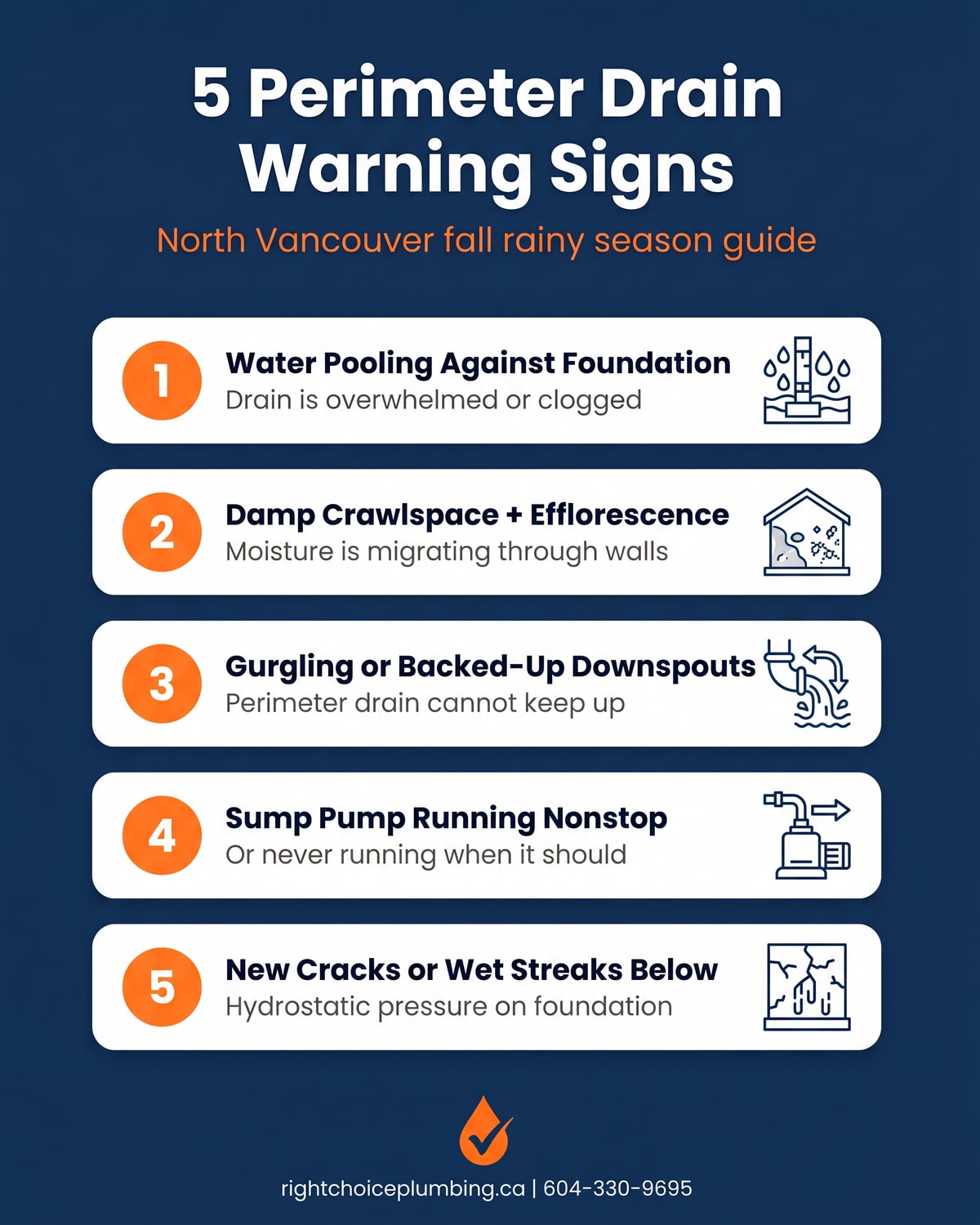
5 perimeter drain warning signs to act on this fall
Reading the signs separately is one thing. The decision to call is usually triggered when two or more show up at once. Walk the perimeter of your house in a steady rain (not after, during) with this list in hand.
1. Standing or pooling water against the foundation after a rain event
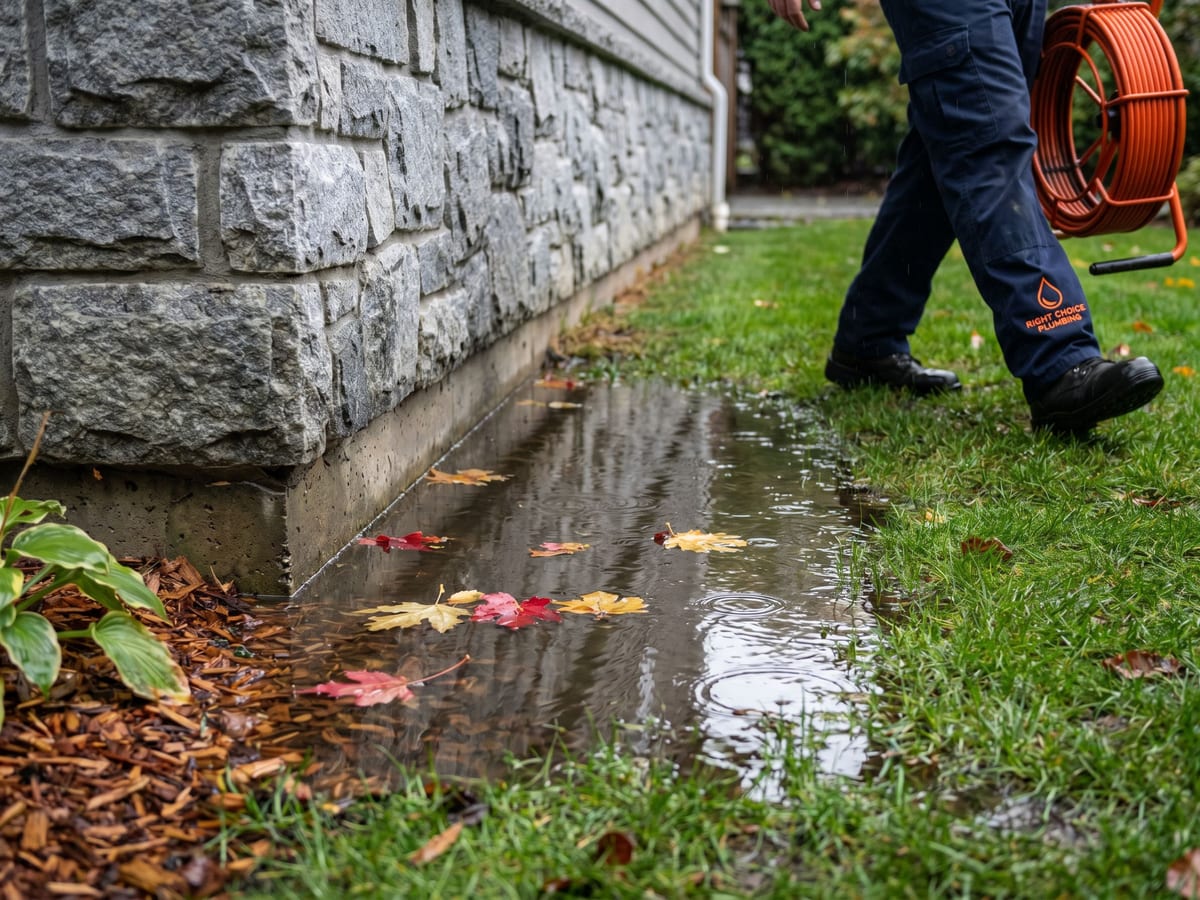
Take a slow walk around the entire perimeter one hour after a steady rainfall stops. Look at the soil and lawn right against the foundation wall, especially at the corners and at any spot under a downspout. If water is still pooled against the foundation, sitting in a puddle that does not drain in 30 minutes, the perimeter drain at that corner is either clogged, collapsed, or never tied in properly. Healthy drains pull water away faster than that.
One common false alarm: a downspout dumping water at the foundation because the extension elbow has come off. Fix the downspout first, then re-test in the next rain. If the pooling persists, the perimeter drain is the next suspect.
2. Damp basement or crawlspace, plus white efflorescence on the wall
Efflorescence is the white powdery mineral deposit that forms on concrete or block walls when water migrates through and dries on the other side, leaving dissolved calcium carbonate behind. A horizontal band of efflorescence on the lower half of your foundation wall, plus a damp earthy smell in the crawlspace, plus a cooler-than-room-temperature feel to the wall, is the perimeter drain telling you it has been losing the battle for years.
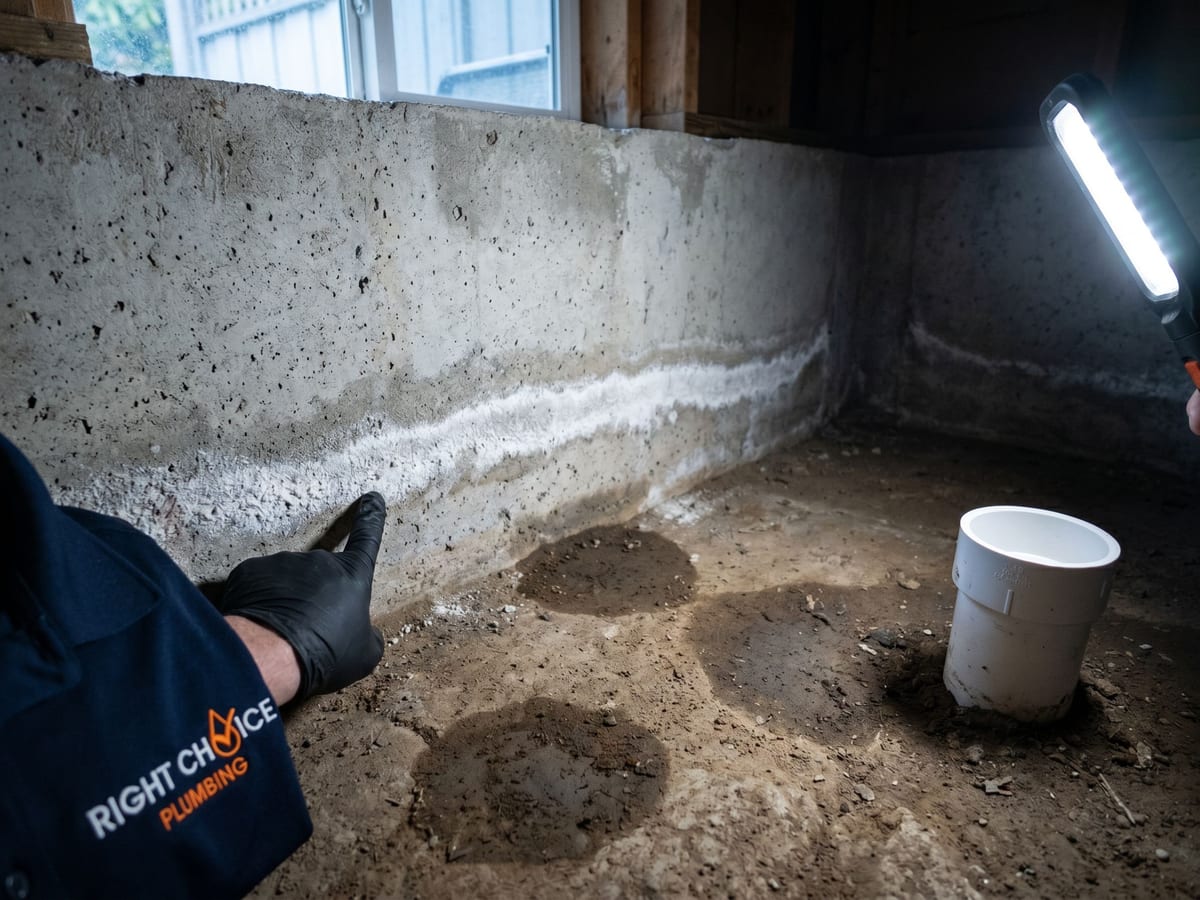
If you can see efflorescence or feel persistent dampness, the drain is not working. We have never opened a perimeter drain on a home with efflorescence and found it clean.
3. Gurgling or backed-up downspouts during rain
In most older North Vancouver homes the downspouts tie directly into the perimeter drain system rather than running to a separate storm connection. When that line is partially clogged, the downspouts back up first. You will hear gurgling near the bottom of the downspout, see water pop up out of the leader elbow in a heavy rain, or notice water running down the outside of the downspout instead of through it.
This is one of the earliest signs and one of the easiest to spot. Walk around in a steady rain and listen. If a downspout sounds like a struggling kitchen sink draining, the perimeter drain it ties into is on its way out.
4. Sump pump running constantly (or not running when it should)
A healthy sump pump in a heavy North Shore storm cycles every 10 to 30 minutes for a few seconds at a time. A pump running continuously, or starting and not stopping, is either failing or being asked to move water from a drain that is no longer carrying it away. A pump that never runs through a major rain event when neighbours' pumps are cycling is also a flag.
Lift the sump cover during the next heavy rain and watch one cycle. If the inflow is a brown silty trickle rather than a steady clean stream, the perimeter drain feeding the pit is loaded with sediment. We have replaced sump pumps that turned out not to be the actual problem.
5. New cracks in the foundation or wet streaks on the rim joist
Hydrostatic pressure (saturated soil against the foundation) is what eventually breaks foundation walls when the perimeter drain stops moving water. New hairline cracks at the corners of poured walls, mortar joints opening up on a block foundation, or wet streaks running down from the rim joist into the basement during a heavy rain are all symptoms of the same root cause.

Any new crack wider than a credit card, any crack that has visibly grown between spring and fall, or any crack actively damp during rain is a perimeter drain call (and sometimes a structural call after that).
What to do this week, this month, and before the heavy rains
If you saw one warning sign on the walk, you have time. If you saw two or more, the time is shrinking. Here is the staged plan we walk North Shore homeowners through every fall.
This week (the free 30 minutes that prevents a $20,000 repair)
Clean every gutter and downspout end to end. Check that every downspout extension or splash block carries water at least four feet away from the foundation. Pull mulch and soil back from any visible perimeter drain cleanout caps so they are accessible. Confirm the sump pump (if you have one) runs by pouring 20 litres of water into the pit. None of this is the fix, but it eliminates false alarms and tells you whether the drain itself is the suspect. The City of North Vancouver's stormwater management program targets up to 70% source control on new developments for a reason: the less water you funnel into the perimeter drain in the first place, the longer it lasts.
This month (book a perimeter drain cleaning and camera inspection)
If the warning signs persist after the gutters and downspouts are clean, book a perimeter drain cleaning North Vancouver homeowners can rely on: a camera scope plus hydro flush through the existing cleanouts. The scope answers four questions: is the pipe clay, PVC, or HDPE; is it intact or collapsed; is it silted, rooted, or clear; and is it connected to a storm main, a sump, or to daylight. The flush usually goes ahead the same day if the line is intact, and on a typical North Vancouver home runs in the high hundreds to low thousands depending on access.
Before the heavy rains (the repair or replace decision)
If the camera shows collapsed sections, full root packs that will not flush, or bellies holding standing water, the decision becomes spot repair vs full replacement. We always quote both, with the camera footage attached, so you can see exactly what you are paying to fix. Spot repairs on a single corner usually finish in 1 to 2 days. A full replacement with new drain rock, filter fabric, sump, and discharge is a 3 to 7 day excavation depending on lot complexity.
Repair vs replace? When each makes sense
Repair makes sense when: the home is post-1980, the pipe is intact PVC or HDPE for most of its length, the clog is silt or roots that hydro-jet cleared, only one or two corners show damage on camera, the sump and discharge line are sound, and the cost of a spot repair is meaningfully less than a full replacement.
Replace makes sense when: the home is pre-1980 with original clay tile, multiple sections are collapsed or full of mud bellies, the existing pipe has no cleanouts at all, hydro-jet flushing makes no difference after two passes, the sump is over 25 years old, or two or more corners show damage on camera. We will tell you which side you are on with the footage right there on the screen, before any work starts.
What perimeter drain service looks like in North Vancouver
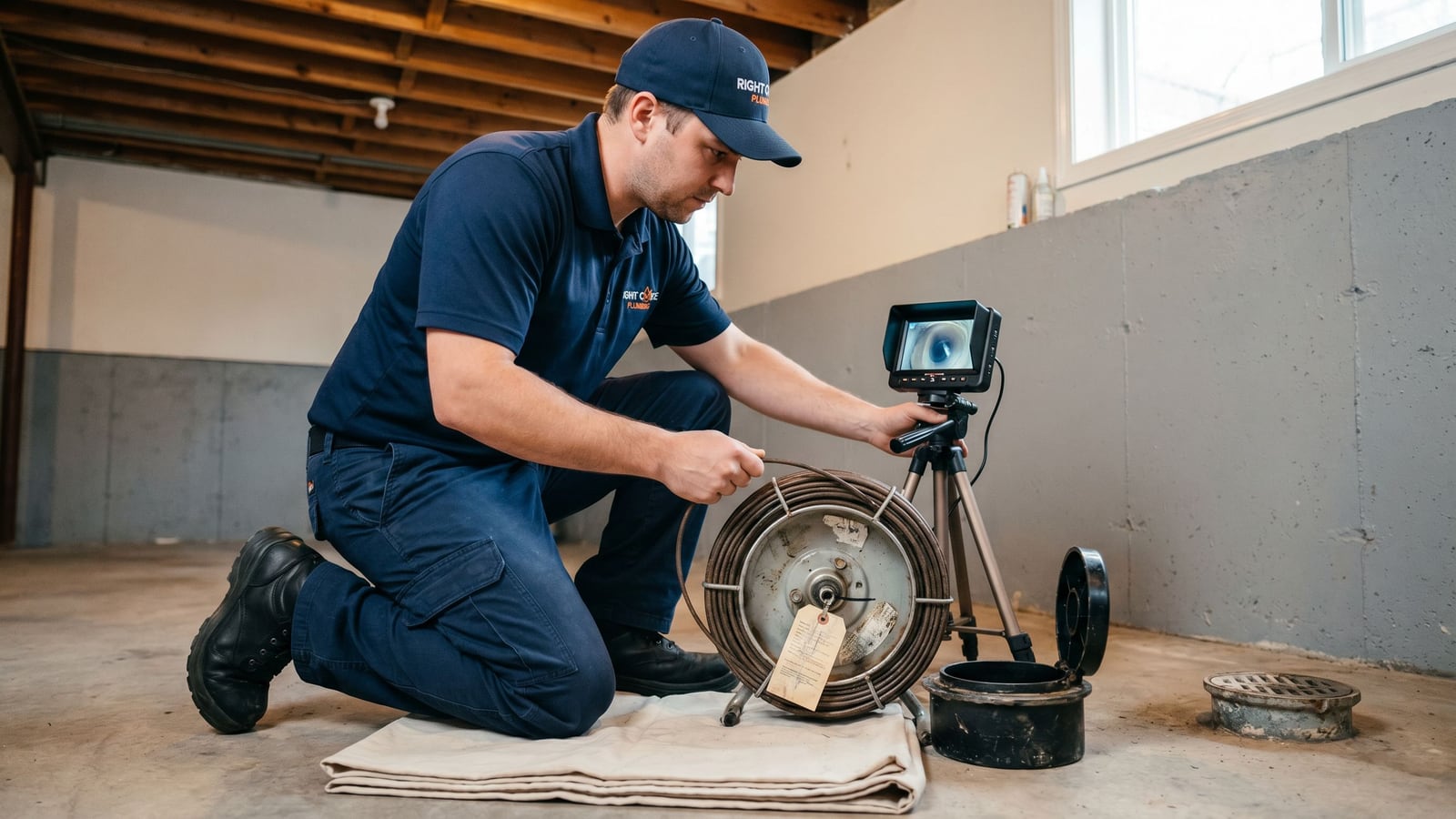
A standard perimeter drain cleaning on a North Vancouver home is a camera scope plus hydro flush, 3 to 5 hours from arrival to finish. The licensed technician locates each cleanout, runs the jetter cable around each side of the home, scopes each line with the push camera, captures footage of every flag, then walks you through what is happening under the soil. Most flushes restore enough flow to push a full North Shore fall through without trouble.
Spot repairs are 1 to 2 days, typically a 4 to 8 foot excavation at one corner, a fresh section of perforated HDPE wrapped in filter fabric, a re-bed in clean drain rock, and a backfill. A full replacement is 3 to 7 days, includes a new run on every exterior wall, a new sump pit and pump sized to the home, and a new discharge line. For older homes with storm and sanitary tied together, we separate them where the bylaw requires. Permits in the District of North Vancouver, City of North Vancouver, District of West Vancouver, and City of Coquitlam are pulled by us and coordinated with the inspector.
If the camera shows the clog is actually in the sewer lateral rather than the perimeter drain (the two systems share access points on some older homes), we shift the scope to a sewer line repair and quote that separately. Across the North Shore and the Tri-Cities we run the same crew, the same uniform, and the same workmanship warranty. The North Vancouver plumber team that handles Lonsdale, Lynn Valley, Deep Cove, Edgemont, and Capilano Highlands is the same team that covers the West Vancouver plumber routes through Ambleside, Dundarave, and the British Properties, and the same crew that runs the plumber Coquitlam calls in Maillardville, Burke Mountain, and Westwood Plateau. If your perimeter drain is failing this fall, the call is the same: 604-330-9695, and we are Right Choice Plumbing.
FAQ
How often should I have my perimeter drain inspected in North Vancouver?
For pre-1980 homes on the North Shore, every 2 years is the right cadence, with a hydro flush every 3 to 5 years even if no warning signs are present. For 1980s to 1990s homes, every 3 to 4 years works for most properties. Post-2000 HDPE systems can usually go 5 to 7 years between professional flushes, but an annual walk around the foundation during a heavy rain still pays for itself.
Can I hydro flush my own perimeter drain with a pressure washer?
Honestly, no. A household pressure washer puts out enough pressure but not enough flow, and the wrong nozzle in a perforated pipe will blow water out through the perforations into the soil instead of pushing the clog ahead of it. Professional hydro-jetters use specific nozzles that pull the jet head forward while spraying back against the clog. Trying it with a wand usually makes a partial clog worse, not better.
Are perimeter drains and French drains the same thing?
For a North Vancouver homeowner's purposes, yes. Perimeter drain, weeping tile, foundation drain, drain tile, and French drain all refer to the same perforated pipe that wraps the footing of the home and intercepts groundwater. The phrase French drain technically refers to any gravel-filled trench drain, so a yard drain across a wet lawn is also a French drain. When a North Shore homeowner says French drain backup, they almost always mean the perimeter drain around the foundation.
How much does perimeter drain cleaning cost in North Vancouver?
A camera scope plus hydro flush on a typical 2,000 to 3,000 square foot North Vancouver home usually lands in the high hundreds to low thousands of dollars, depending on access, the number of cleanouts, and how packed the line is. Spot repairs jump into the low thousands. Full replacements are five-figure projects. We give a flat-rate quote with the camera footage attached before any work starts.
Will replacing my perimeter drain dry out my crawlspace?
If water is coming in because the perimeter drain is no longer carrying it away, restoring the drain typically resolves the moisture. If the moisture is condensation from a poorly vented crawlspace, plumbing leaks under the slab, or a separate water-table issue, the drain is not the fix. We rule those out during the diagnostic so you do not pay to solve the wrong problem.
How fast can you respond if my basement is actively flooding tonight?
Same evening in most cases across North Vancouver, West Vancouver, Burnaby, Richmond, Coquitlam, and Vancouver. For active flooding we dispatch 24/7 with a utility pump, a portable sump, and the hydro-jetter on the van so we can move the water out, find the source, and stage the actual repair for daylight if needed. Call 604-330-9695 and we will give you a hard arrival window before the call ends.
The bottom line on perimeter drain warning signs in North Vancouver
So, what are the perimeter drain warning signs you should act on this fall? Standing water against the foundation, efflorescence in the crawlspace, gurgling downspouts, a sump pump that runs nonstop or never, and new cracks or wet streaks on the inside of the foundation. Any one of them on a pre-1980 North Vancouver home is a flag. Any two on any North Shore home is a call.
Walk the perimeter in a steady rain. Watch the downspouts. Lift the sump cover during the next storm. If two or more signs show up, do not wait for the November atmospheric river to make the decision for you. A camera scope plus a hydro flush in September or October is a fraction of the cost of a basement remediation in December. When you are ready, we are one call away at 604-330-9695, day or night, every day of the week.
You might also like
Related plumbing reads
Latest from the blog
Recent posts
Drainage
Sewer Camera Inspection in Calgary: What It Shows, When You Need One, and What It Costs in 2026
A sewer camera inspection in Calgary reveals roots, cracks, bellies and pipe material. Here is what a sewer scope shows, when to book one, and 2026 costs.

Drain Cleaning
Slow Kitchen Drain That Won't Clear? When Snaking Works and When You Need Hydro-Jetting (Edmonton Plumber Explains)
Slow kitchen drain won't clear, even after snaking? Here is the drain snake vs hydro jet call an Edmonton plumber makes, plus real 2026 costs for each.
Need a plumber for this?
Skip the DIY rabbit hole - our licensed Vancouver plumbers cover Greater Vancouver with same-day appointments and 24/7 emergency service. Workmanship warranty on every job.